DESIGN RESEARCH ON FACULTY DECISION MAKING
An end-to-end qualitative research and synthesis project translating faculty practices into actionable design recommendations.
ROLE
UX Researcher
Team of 4
TIMELINE
4 months
CLIENT
College of Information
University of Maryland
OUTCOME
Research Insights
and Design Visions
CONTEXT
Faculty in the College of Information balance teaching, research, and service. While teaching and research are structured and measurable, service work is informal, underdefined, and culturally loaded. Over time, this imbalance contributes to overload, misalignment with career goals, and burnout, especially for early career faculty.
Our clients, faculty members within the College, asked us to investigate how service decisions are actually made and how institutions might better support faculty in navigating them.
CHALLENGE
Faculty decision making does not follow linear or documented processes. Much of it happens through experience, negotiation, and improvisation, making it difficult to design effective institutional support without first understanding these underlying patterns.
RESEARCH
QUESTION
How do faculty at the College of Information manage service expectations, and what factors influence their decisions to accept or decline service work in relation to their professional and personal priorities?
RESEARCH
APPROACH
Our focus was not on outcomes, but on how faculty evaluated options, identified constraints, and navigated tradeoffs in real situations.
Methods:
Contextual interviews with faculty
Interpretation sessions to extract meaning from interviews
Affinity diagramming to surface themes
Modeling to structure decision logic
Speed dating survey to test early design directions
Participatory wall walk to validate insights and gather direction
FROM DATA TO MEANING
Interpretation Sessions
Each interview was followed by a structured interpretation session, allowing the team to collaboratively extract observations, tensions, and implications before memory or bias could set in.
During this phase, we explored multiple modeling lenses to understand faculty behavior.
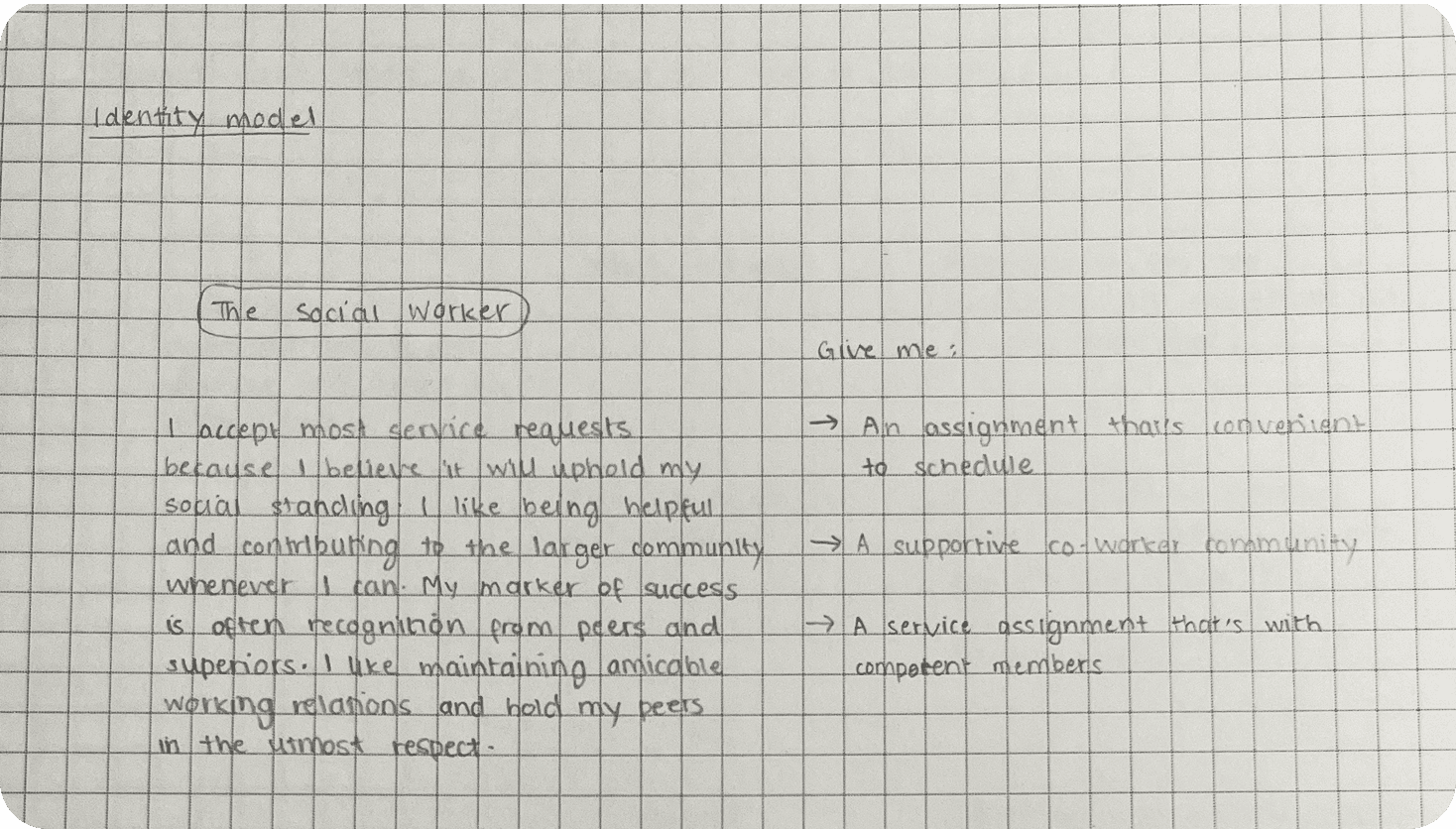
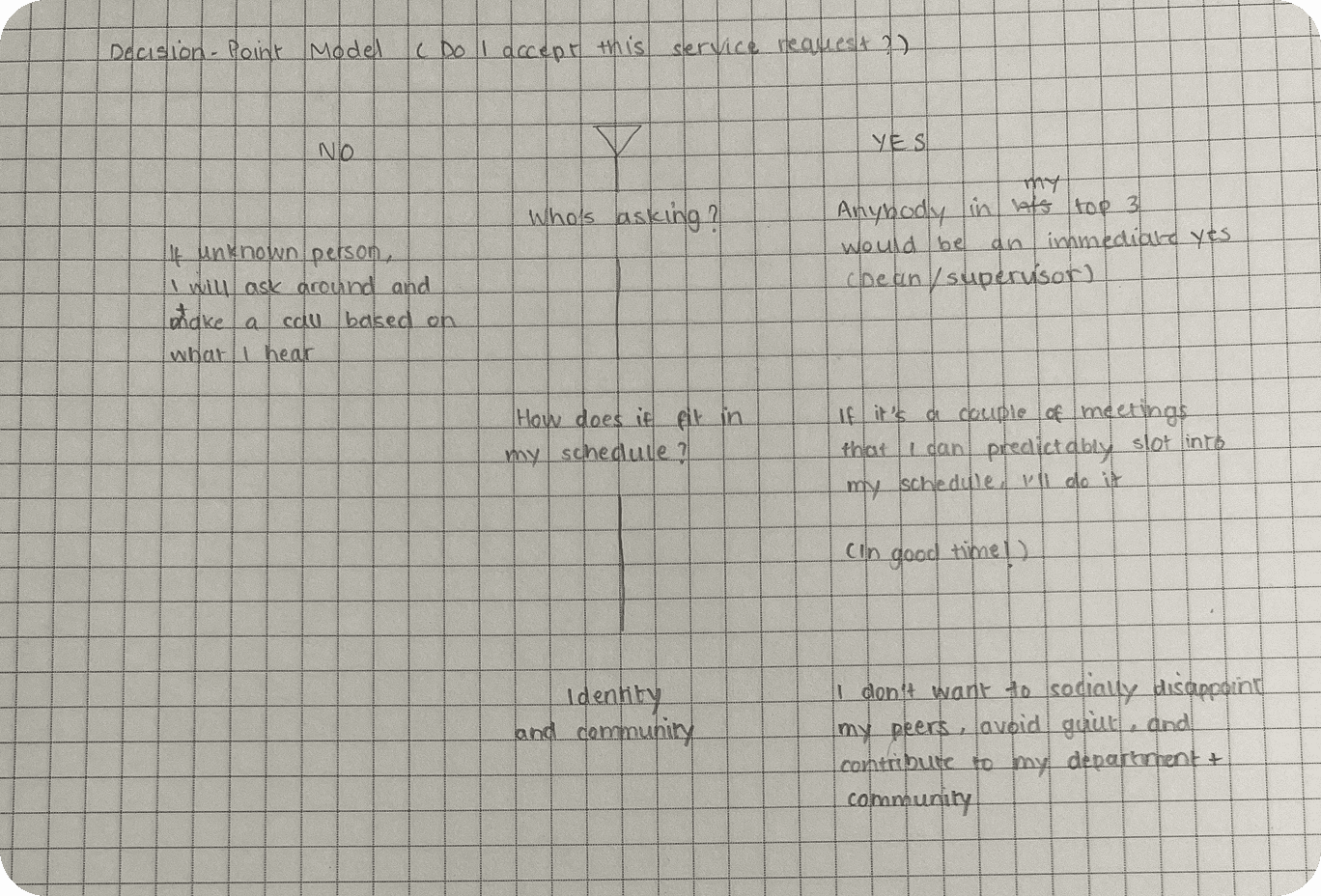
Preliminary identity and decision
point models made during interpretation sessions
SYNTHESIZING INSIGHTS
Affinity Mapping
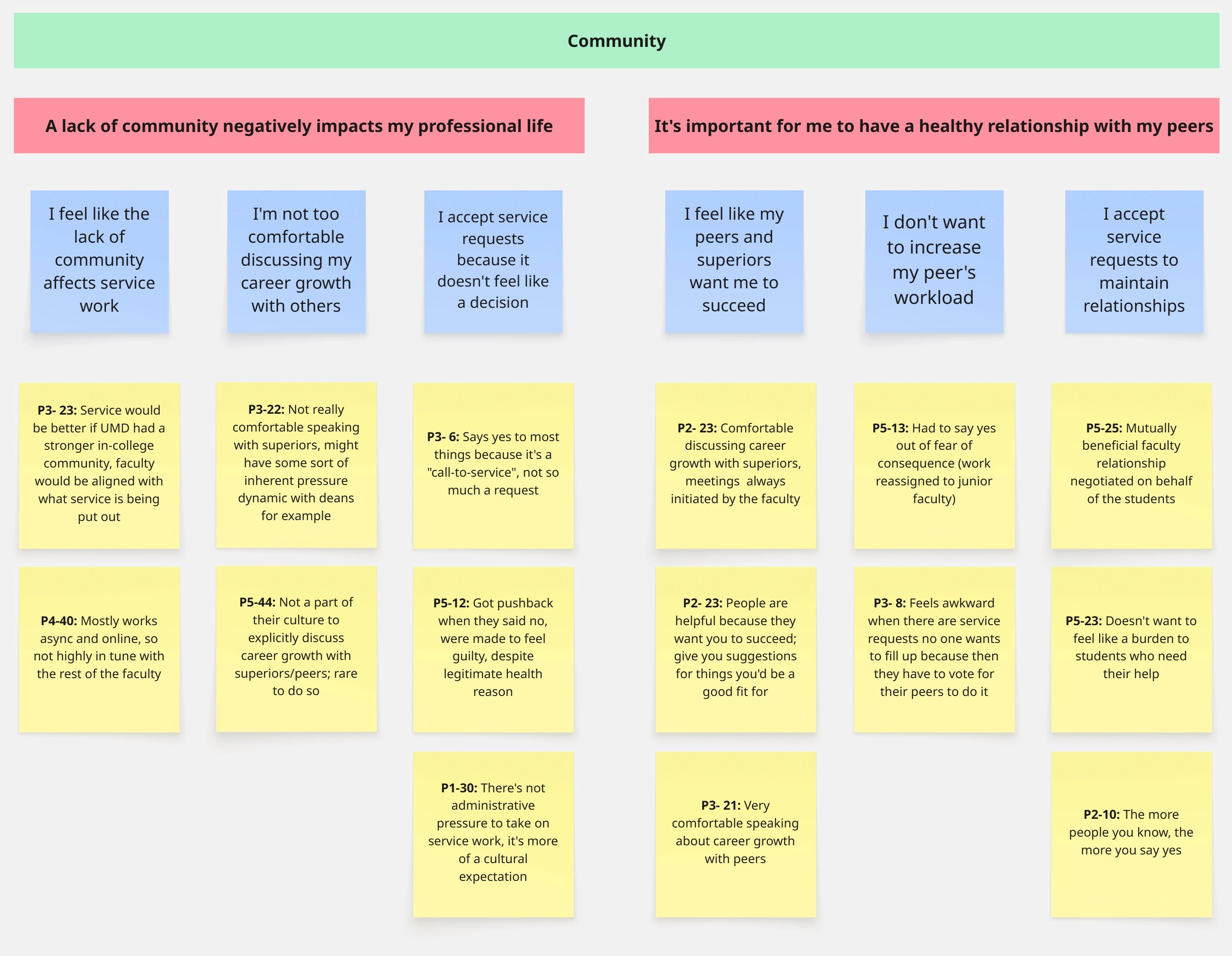
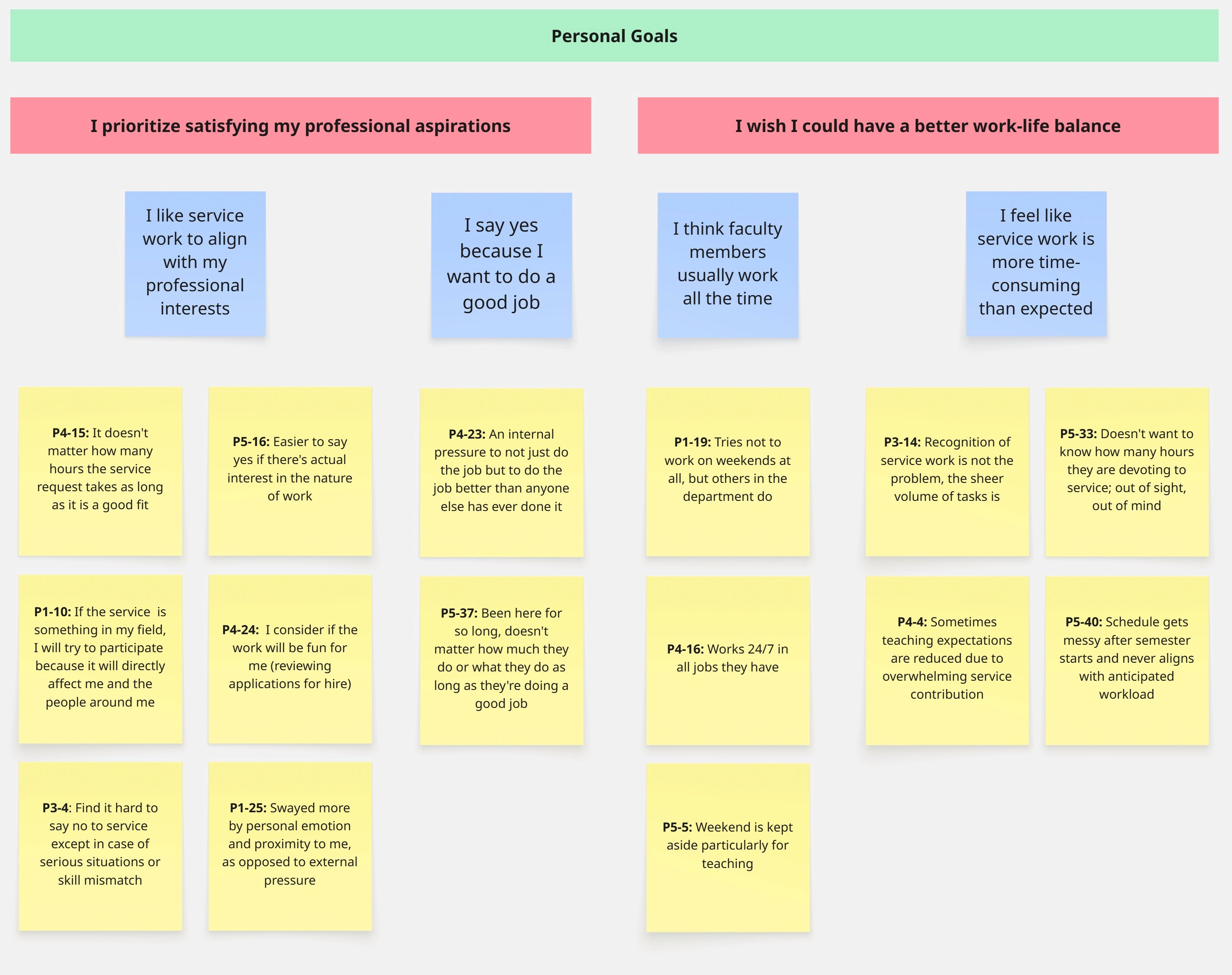
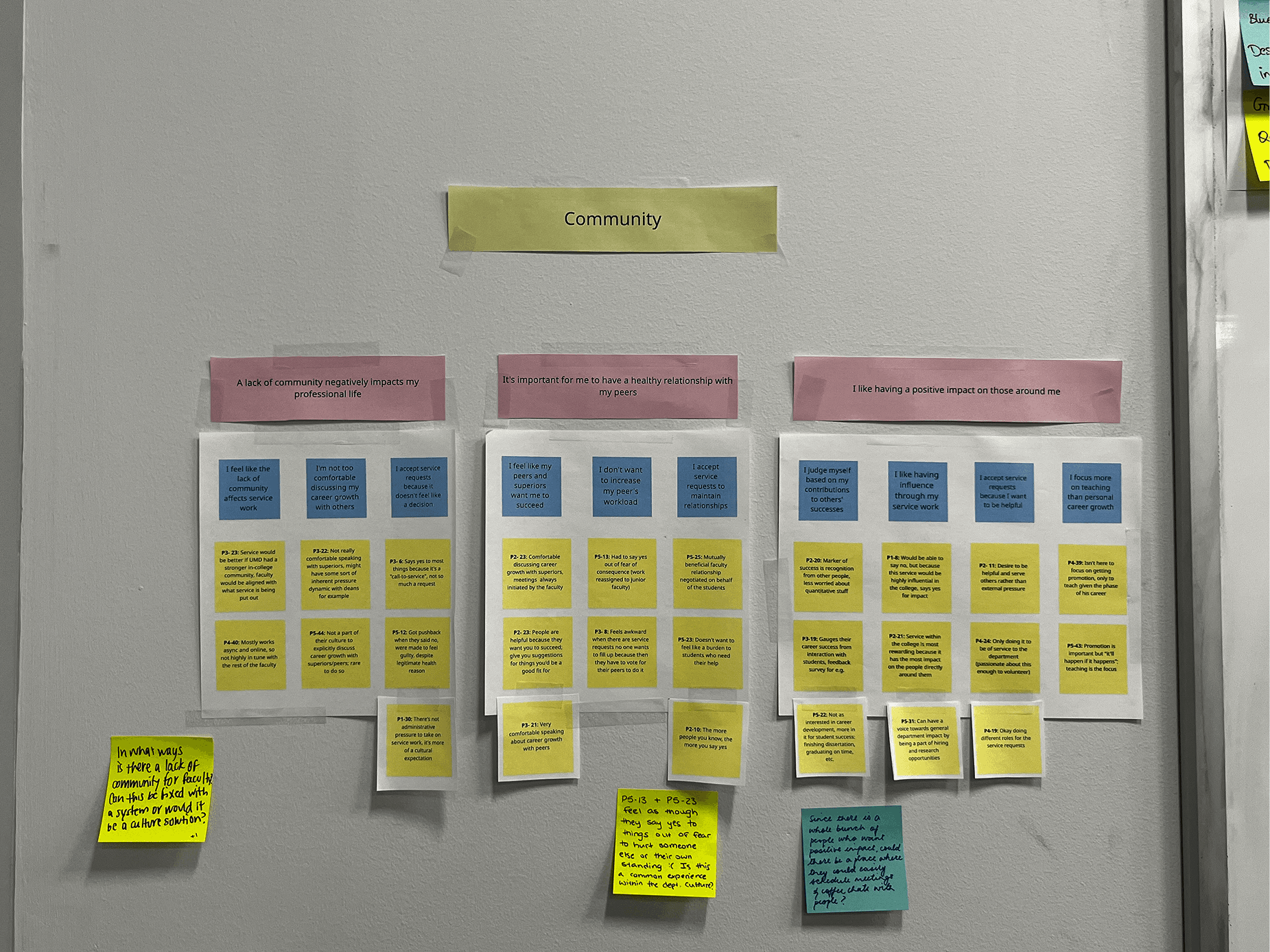
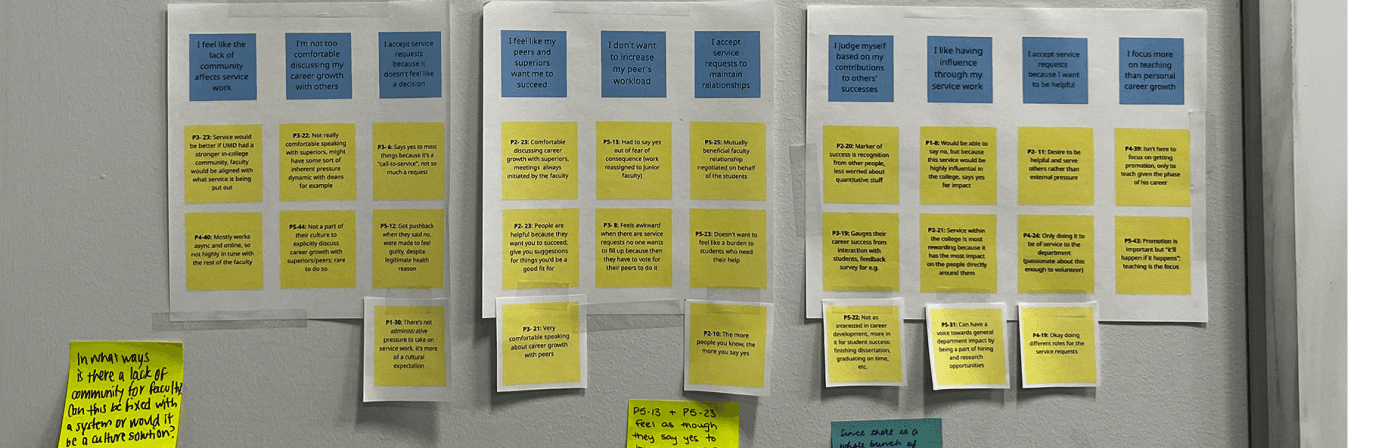
Interview notes were distilled and iteratively clustered into themes. Over multiple sessions, patterns emerged that went beyond logistics and surfaced emotional, cultural, and relational drivers of service decisions.
First large theme identified was
the influence of community in
decision making
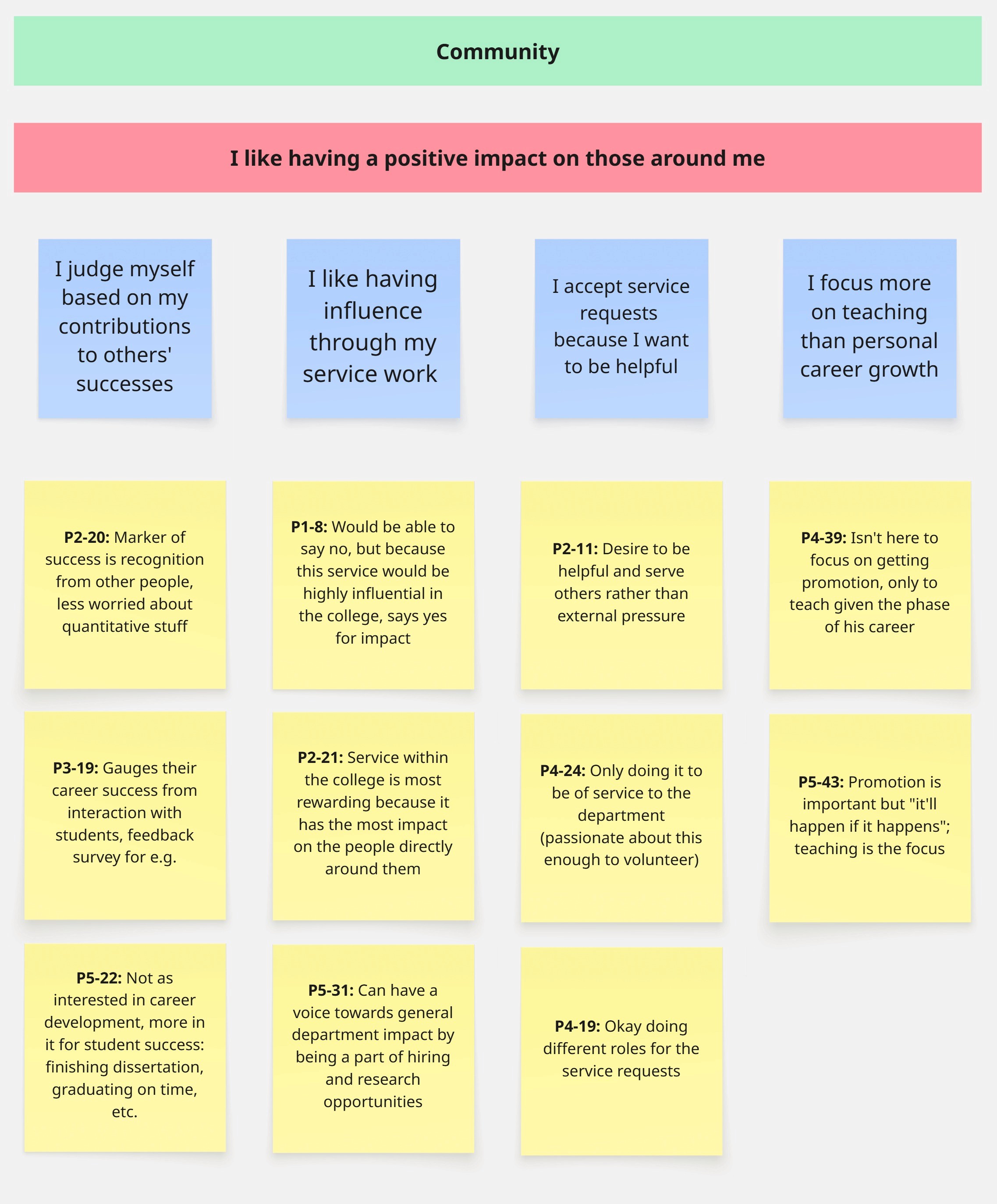
The second theme was the flaws of the service process that we identified
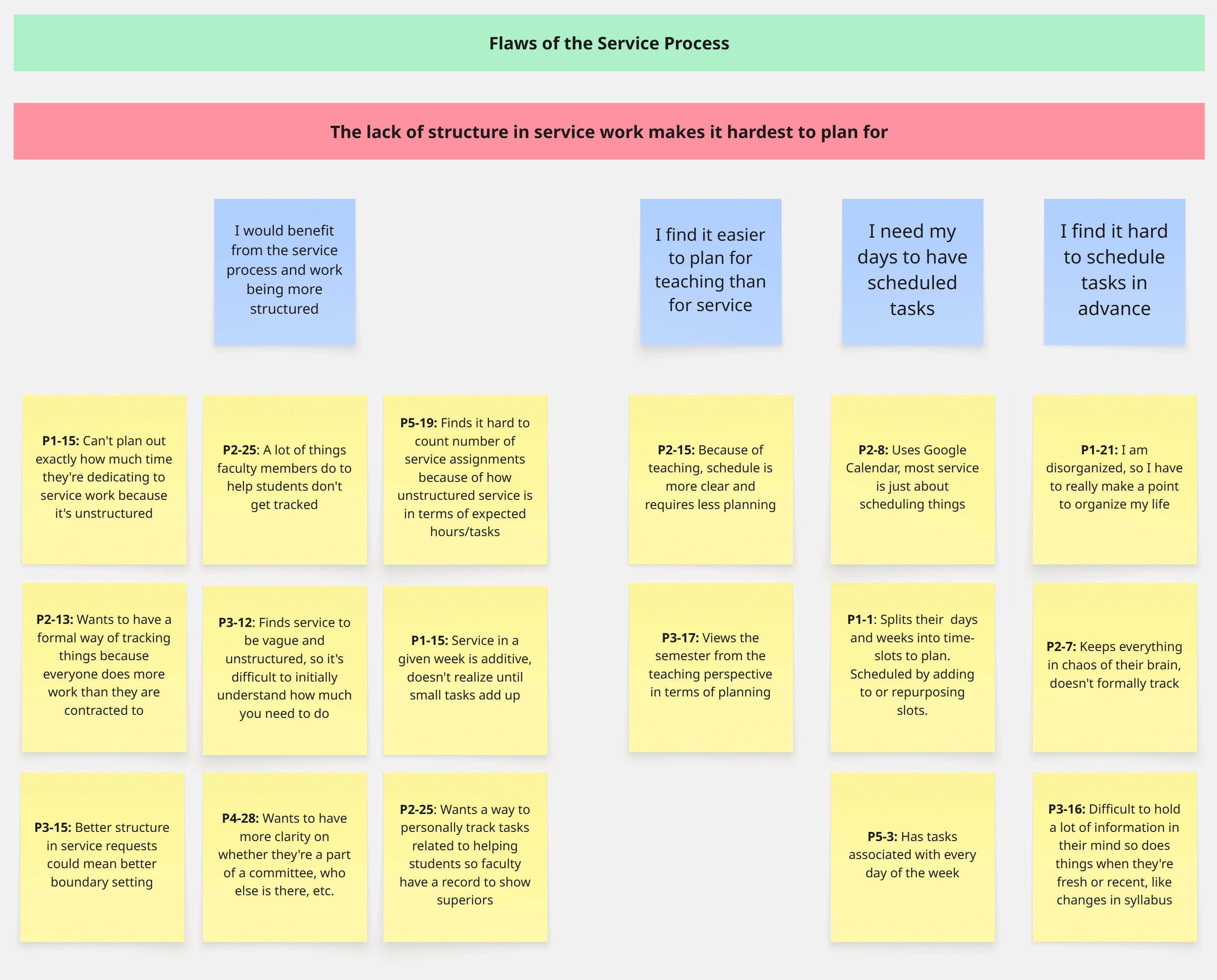
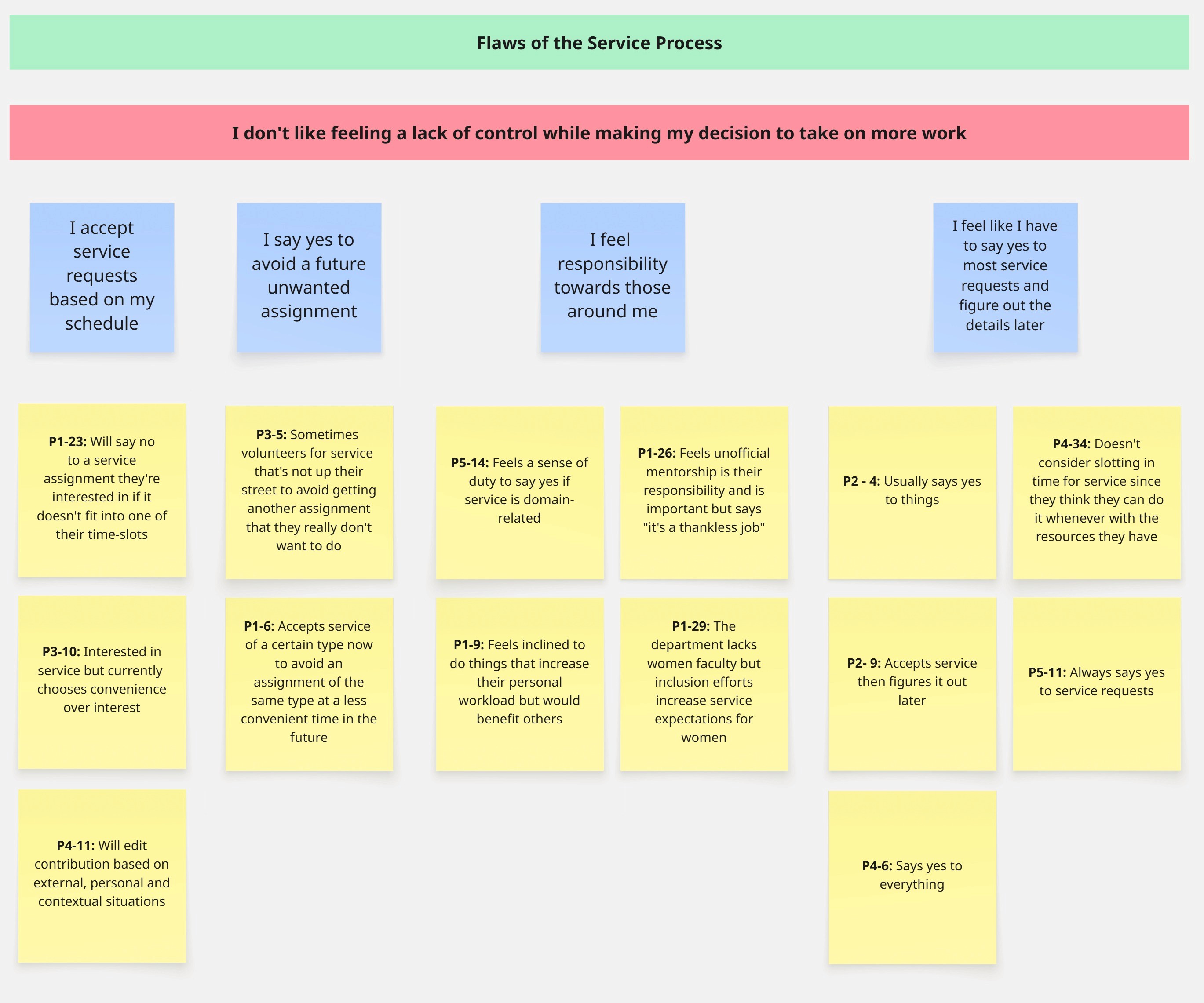
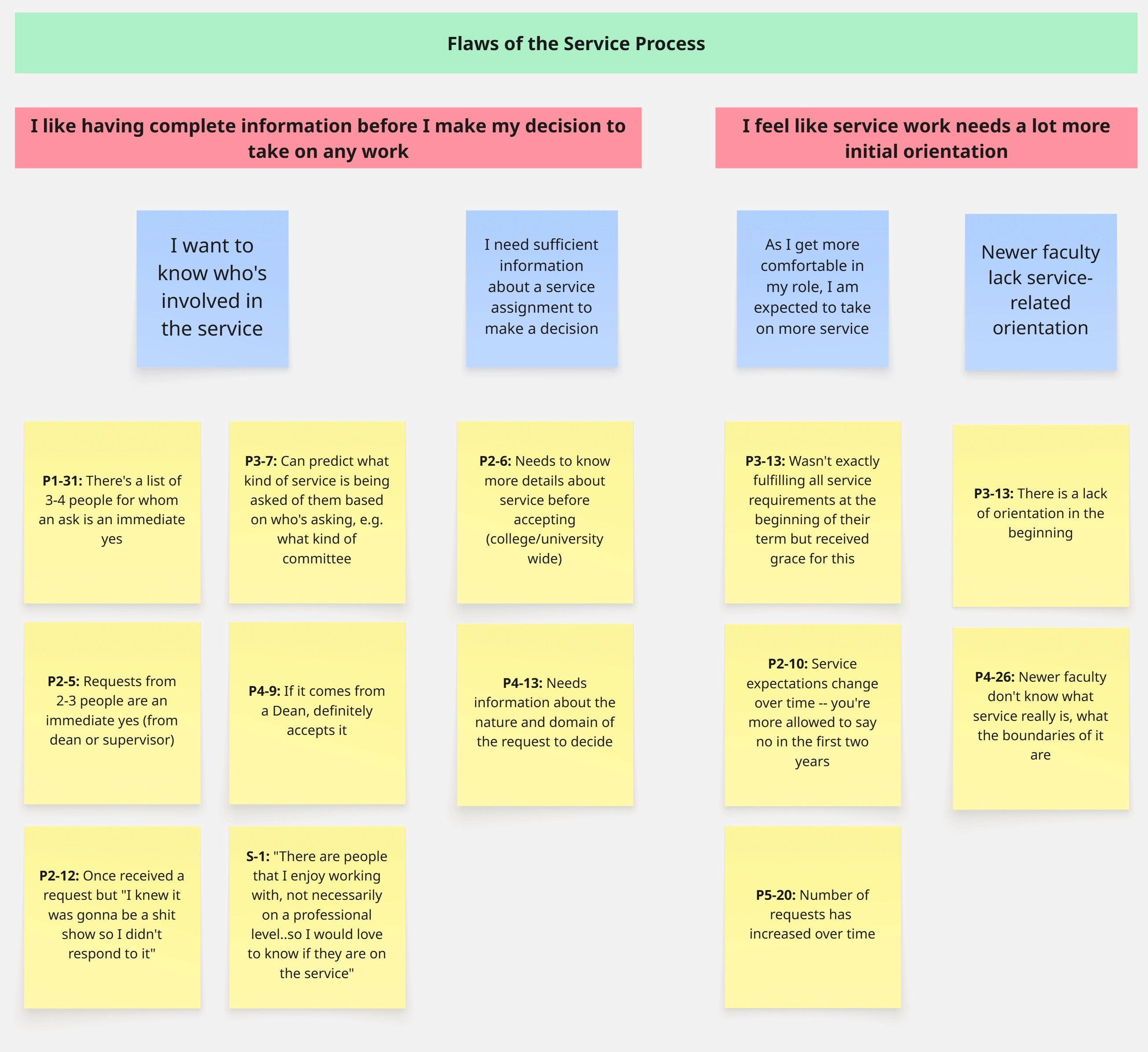
The last theme was how personal and professional goals impacted decisions
KEY INSIGHTS
Service is driven by community obligation, not availability
Faculty frequently accept service work out of care for students, colleagues, and departmental health even when it negatively impacts their workload.
Implication
Any solution that treats service as an individual optimization problem misses the social reality of academic work.
Lack of upfront information leads to reactive decisions
Faculty are often asked to commit to service without clarity around time, scope, or expectations.
Implication
Uncertainty pushes faculty to default to “yes” rather than make informed choices.
Service work is structurally invisible
Mentorship, advising, and informal labor are rarely tracked or acknowledged, despite consuming significant time.
Implication
Faculty lack evidence to reflect on or advocate for their workload.
Cultural and gendered expectations
amplify imbalance
Women and early career faculty reported higher pressure to accept service roles, often framed as being a “good departmental citizen.”
Implication
Service inequity is not accidental. It is reinforced by norms and power dynamics.
MODELING FACULTY DECISION MAKING
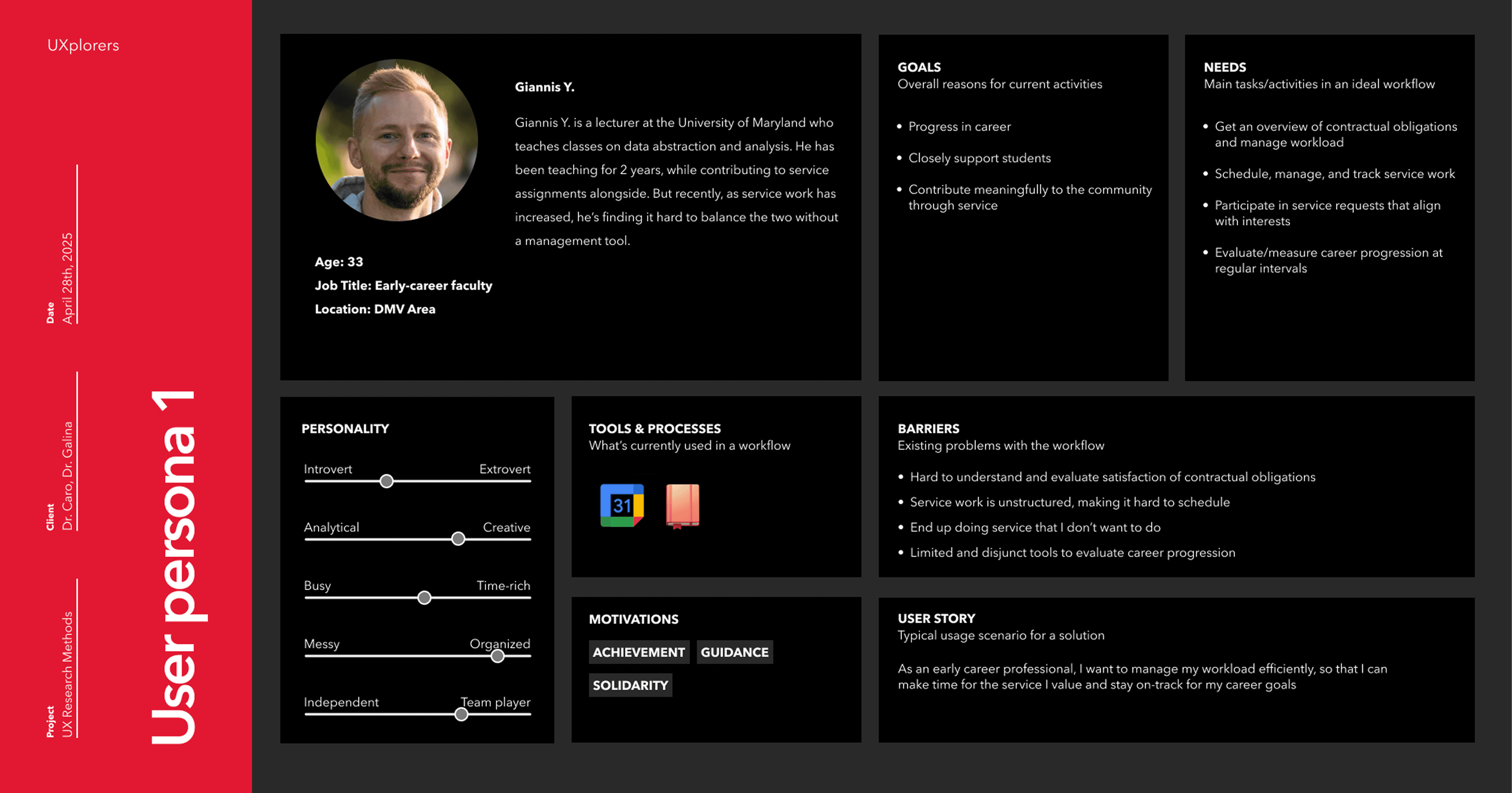
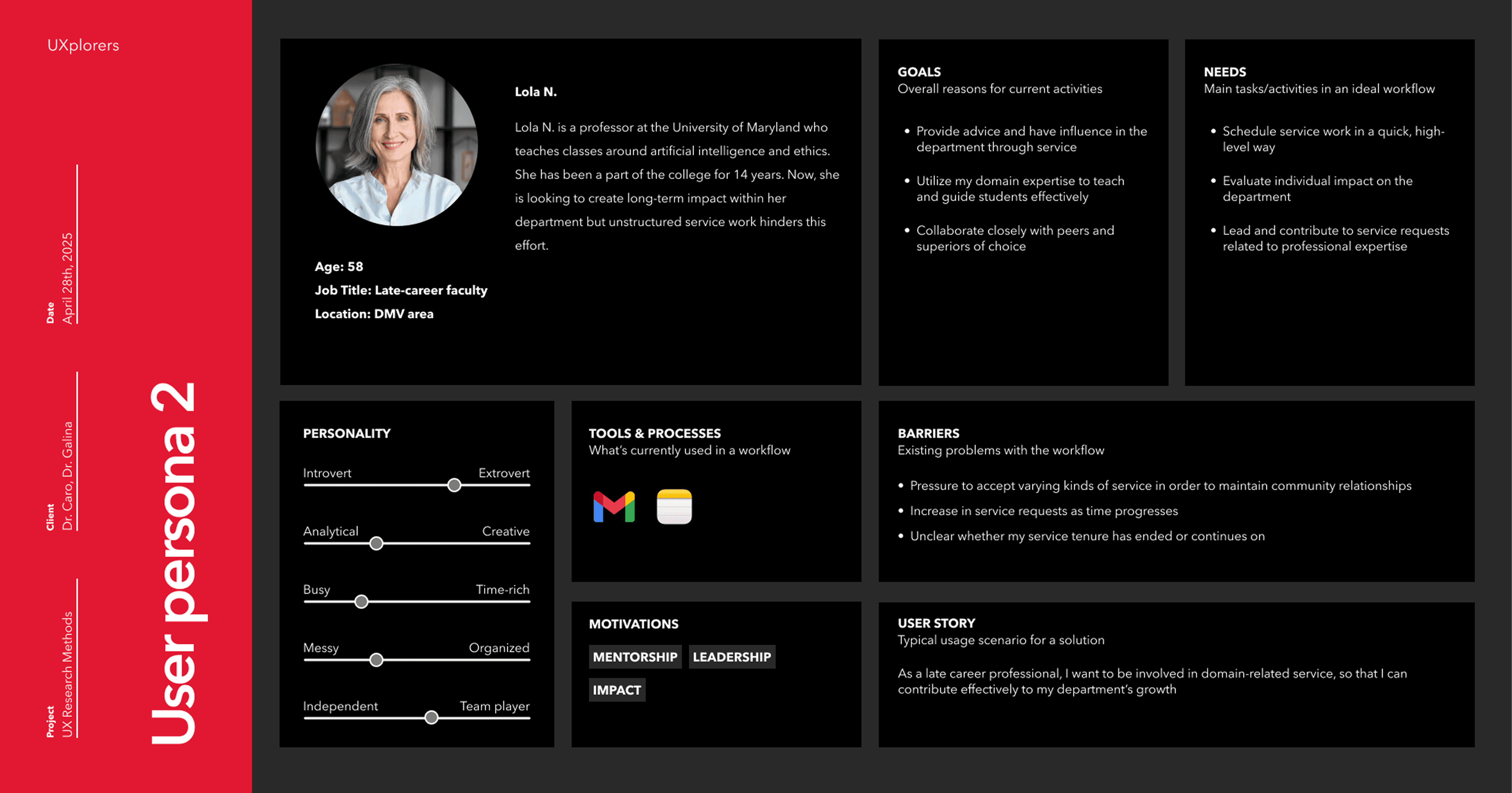
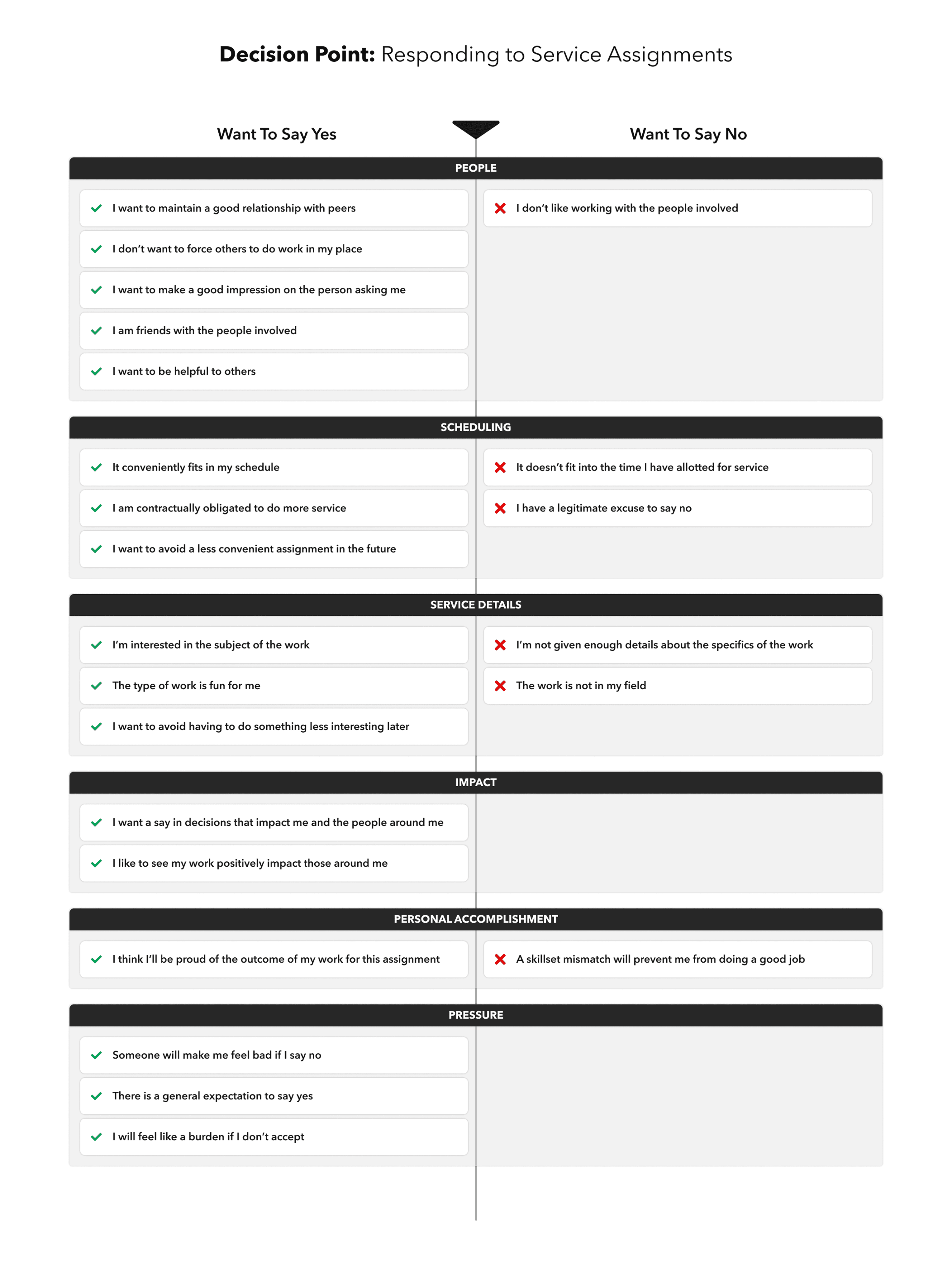
To translate insights into actionable structure, we created personas and a decision point model that reflected how decisions actually happen, not how institutions assume they do.
The decision model revealed that people and relationships consistently outweighed interest or alignment, reframing service acceptance as a socially negotiated act rather than a rational choice.
User personas to model insights about faculty and staff in the department in relation to the service request process
Decision point model to outline influences identified in the decision making process
TESTING EARLY
DIRECTIONS
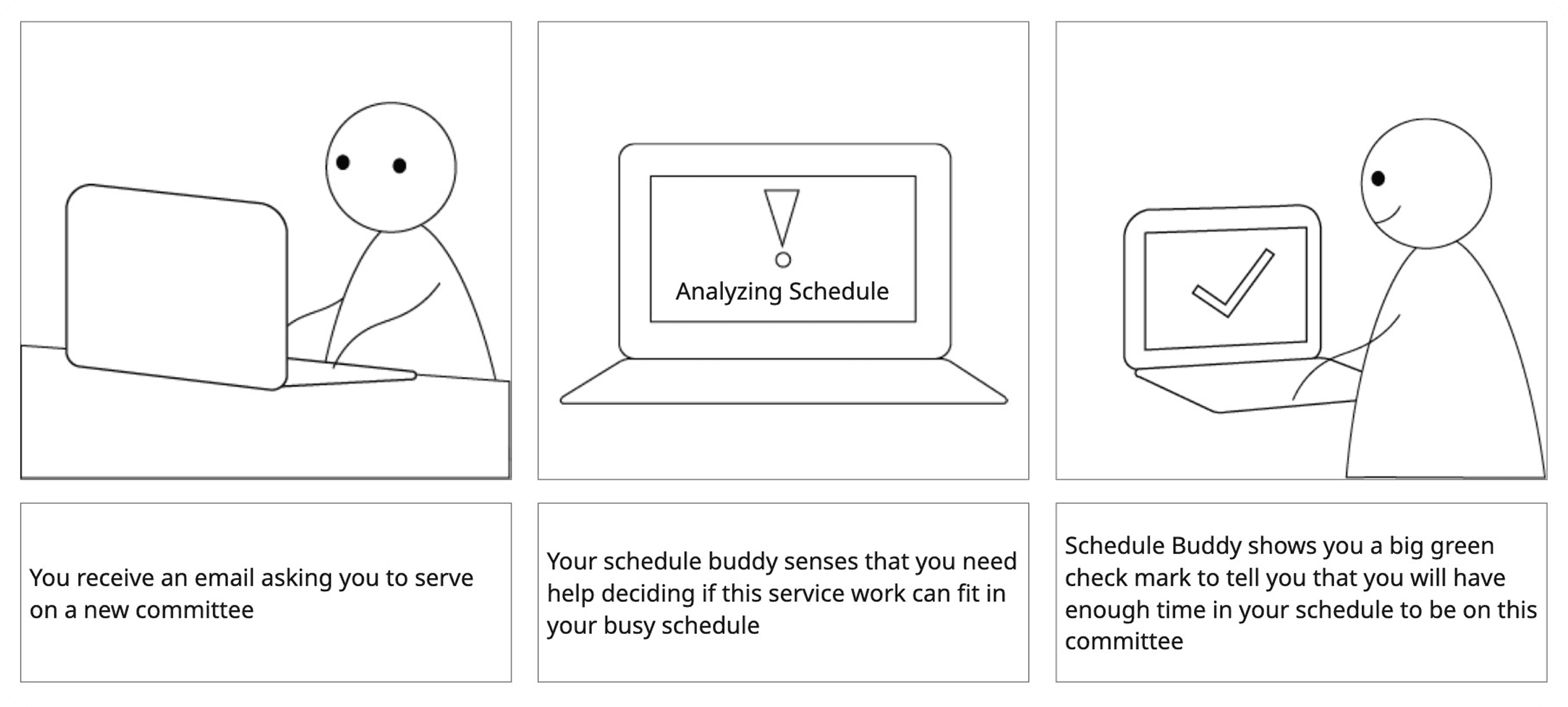
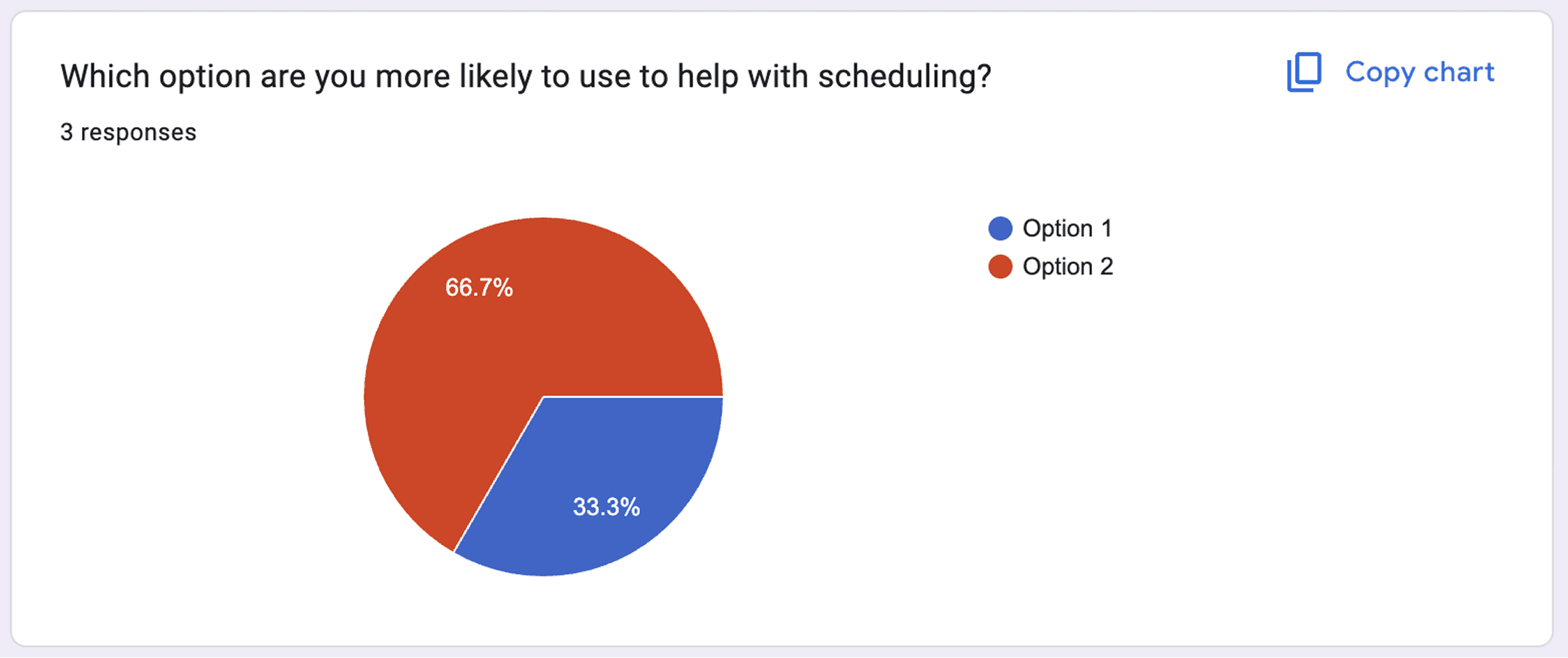
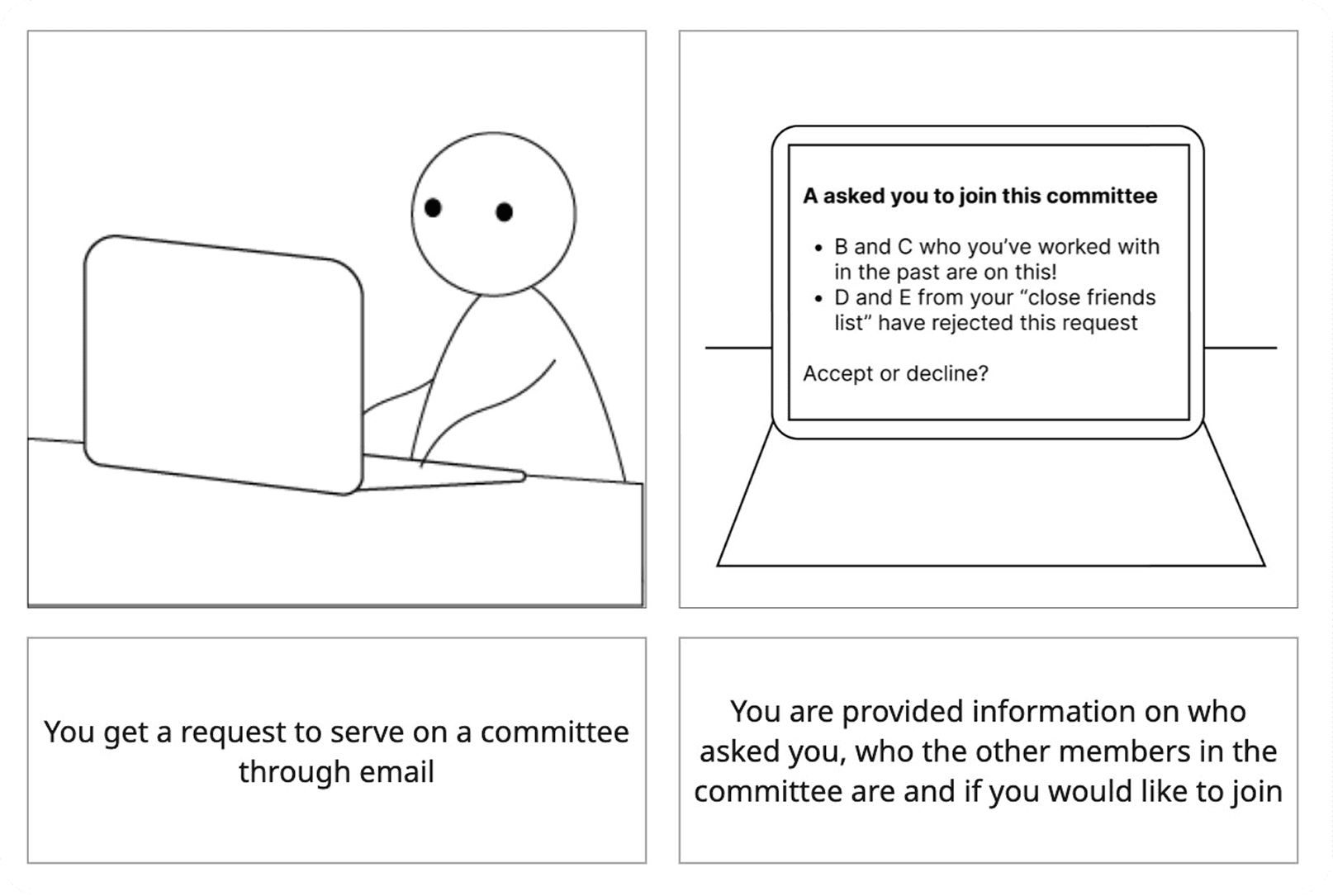
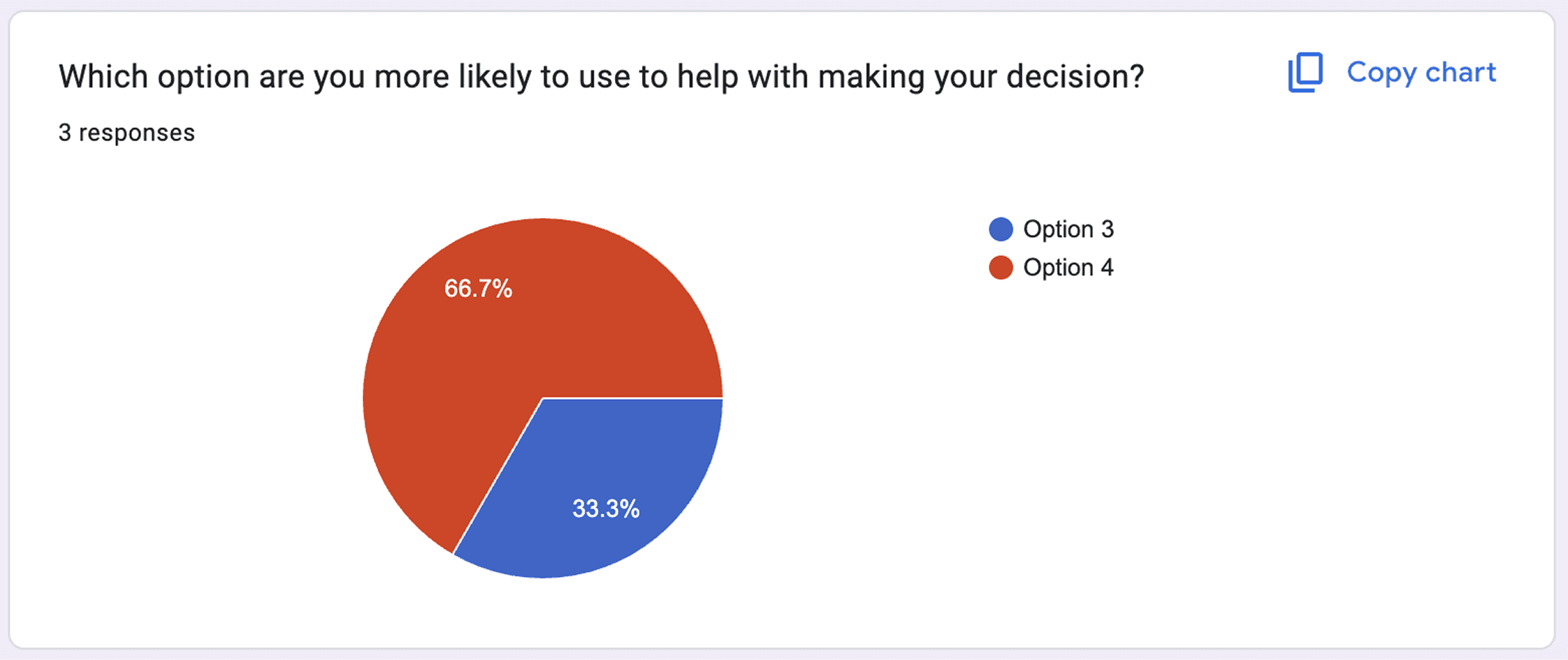
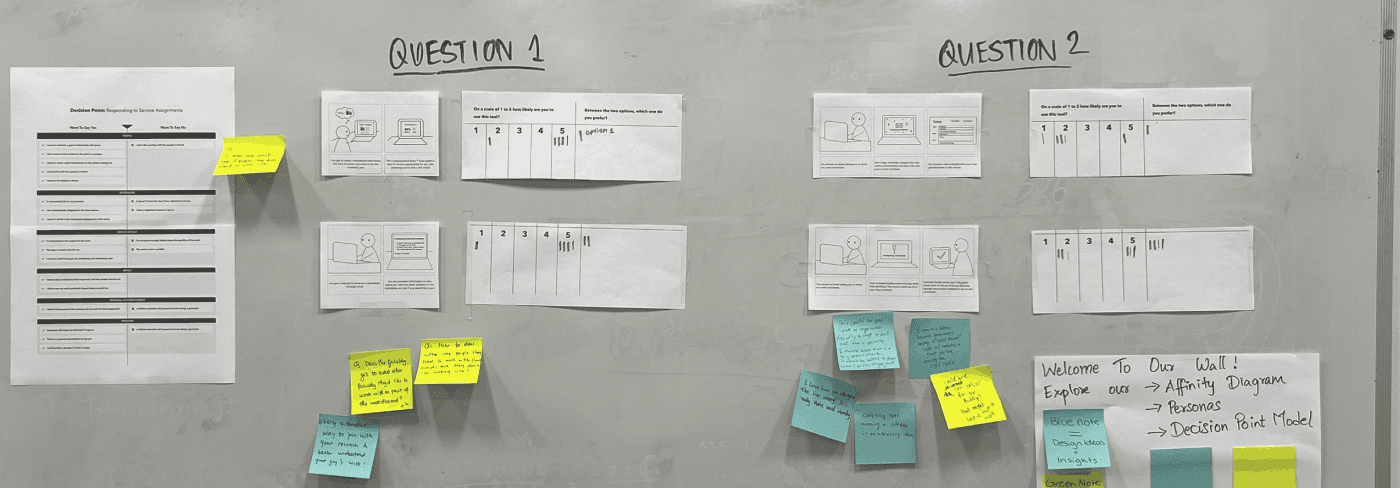
Using insights from interviews and models, we created early concept storyboards and gathered rapid feedback for a speed dating survey
What we learned:
Faculty preferred clarity over complex planning tools
Knowing who they would work with mattered more than algorithmic matching
Community visibility increased trust and willingness to engage
Option 1 preferred by >65% of the participants
Option 4 preferred by >65% of the participants
VALIDATING WITH
THE COMMUNITY
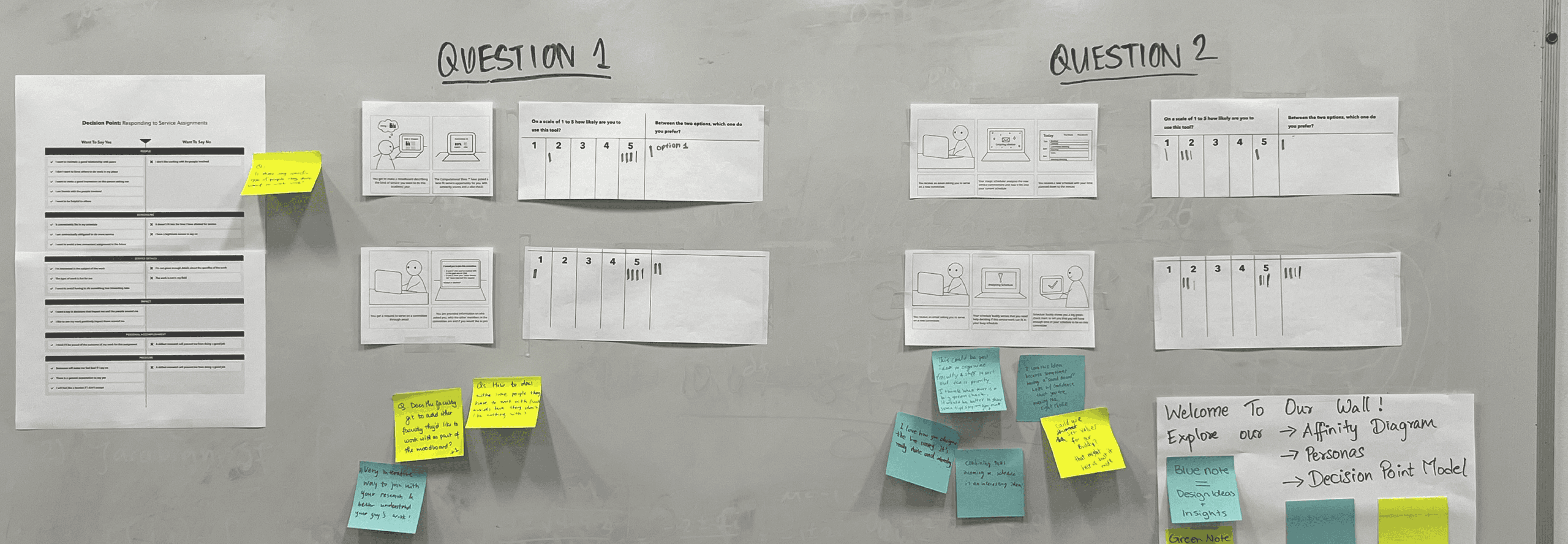
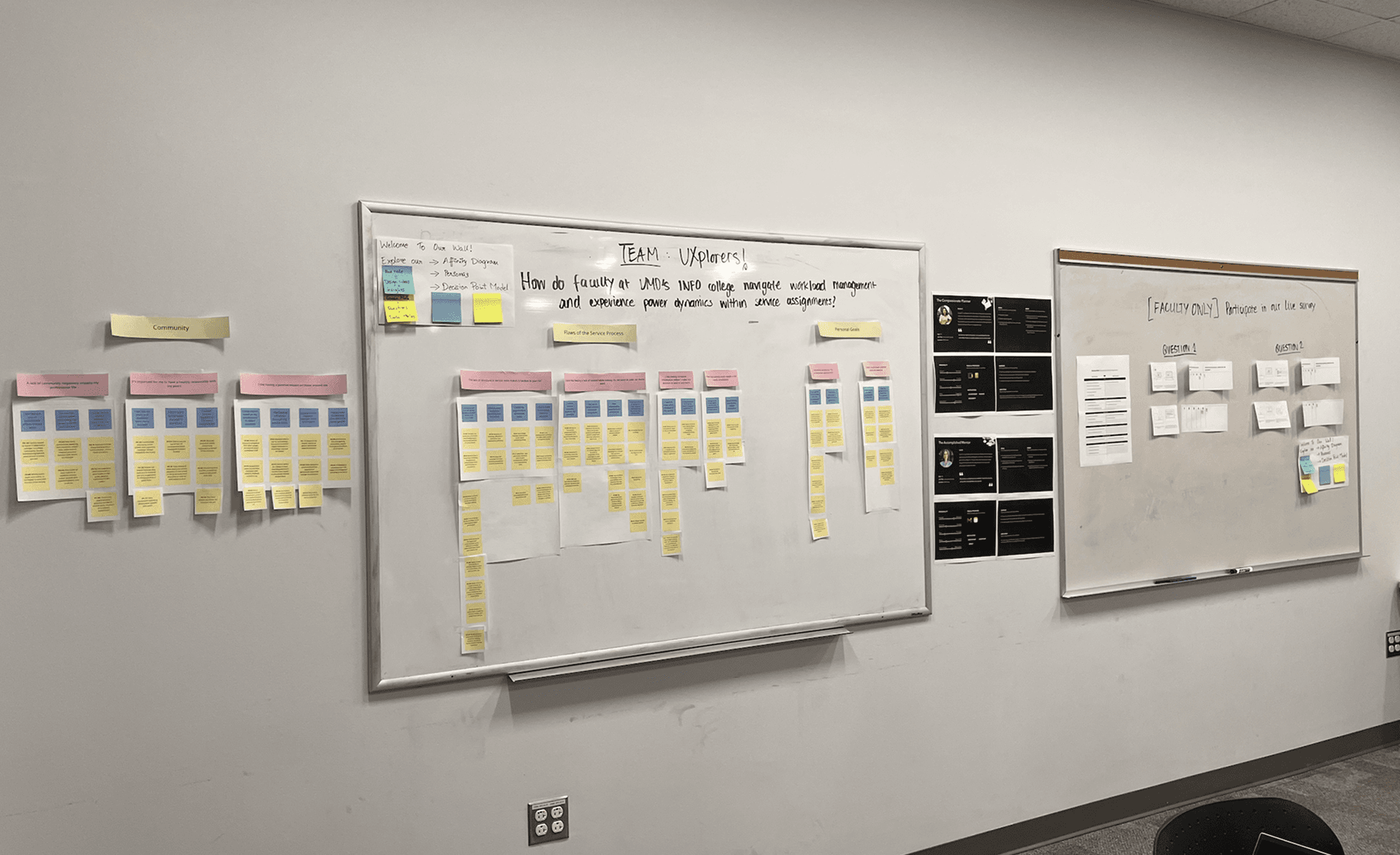
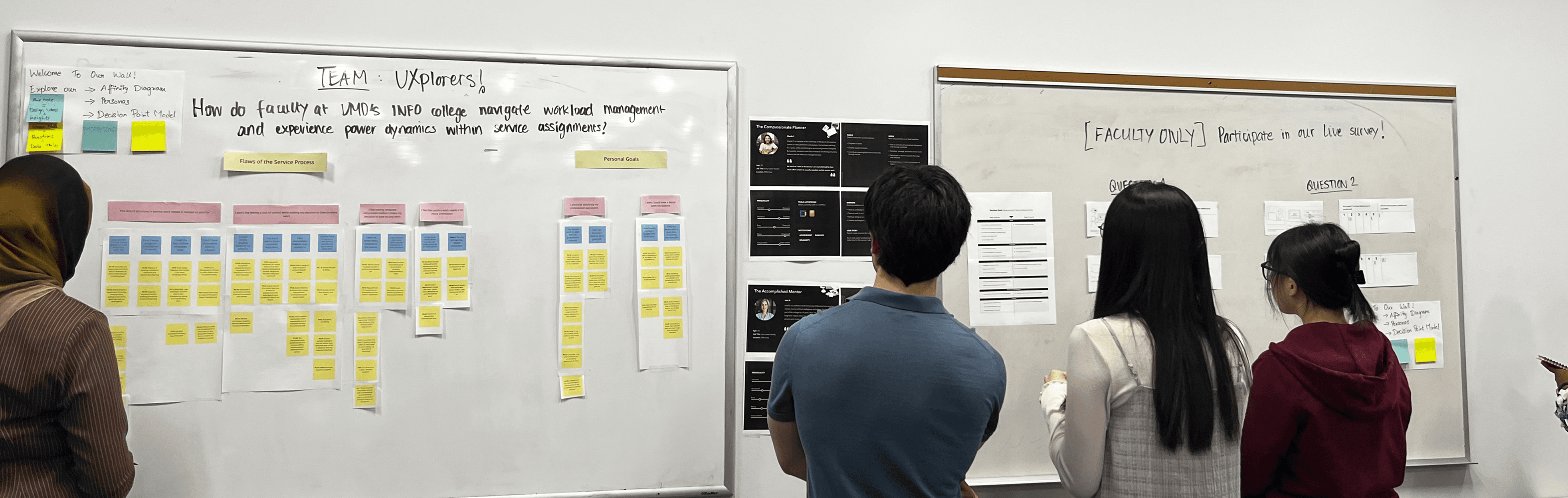
We translated our findings into a physical wall walk and invited faculty to engage directly with the data, models, and early concepts.
This surfaced a second layer of insights, including a strong desire for shared visibility, peer context, and cultural change, not just tools.
The final wall walk display with the affinity diagram, content models and speed dating survey
College of INFO faculty interacting with the insights
Questions and design ideas suggested by the participants
FROM INSIGHTS TO RECOMMENDATION
Visioning
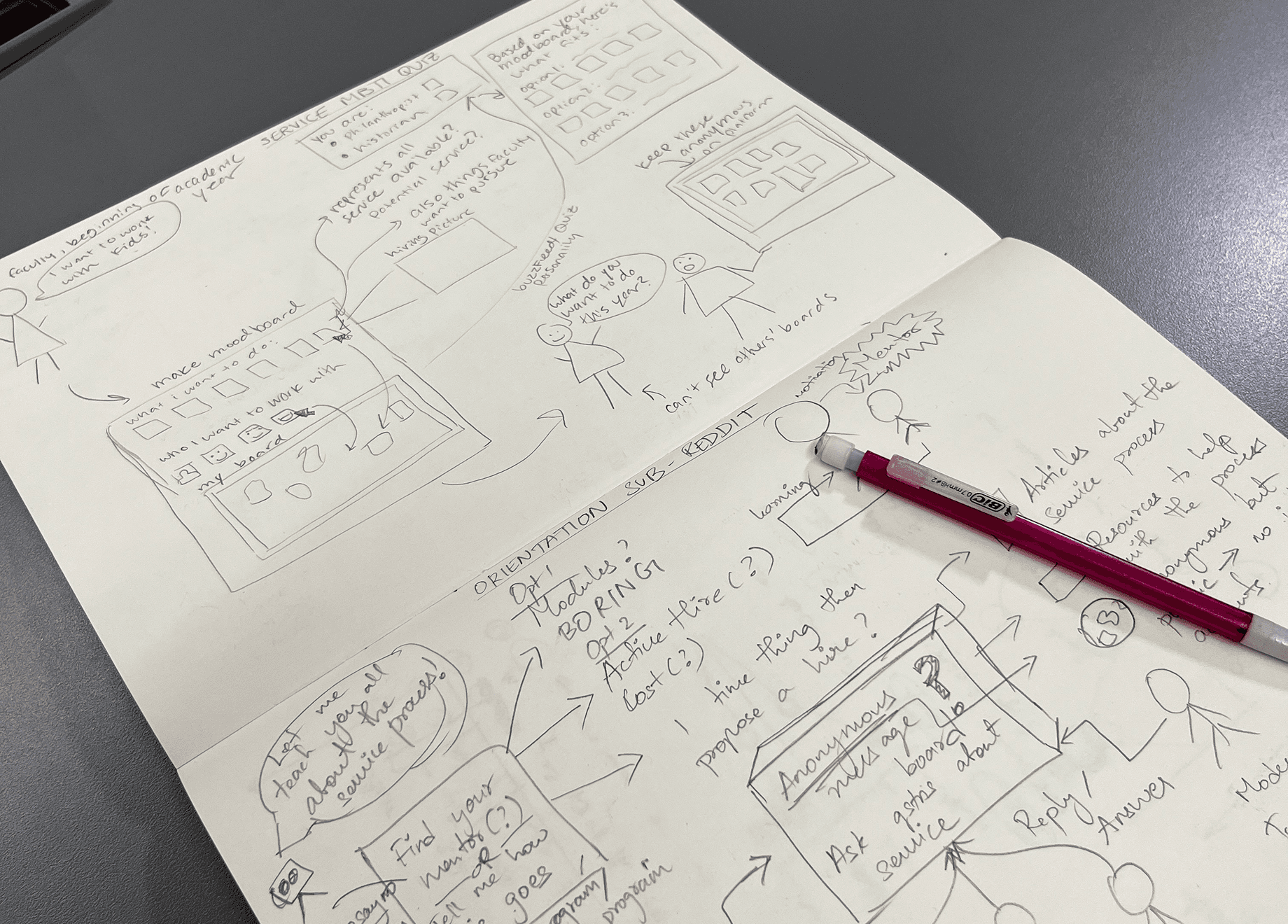
We synthesized wall walk feedback into four “hot ideas” and used a structured visioning process to explore possibilities without prematurely narrowing scope.
This allowed us to separate what was desirable from what was feasible, while preserving the integrity of our findings.
Example of an initial vision sketch
FINAL RECOMMENDATION : TERP SERV
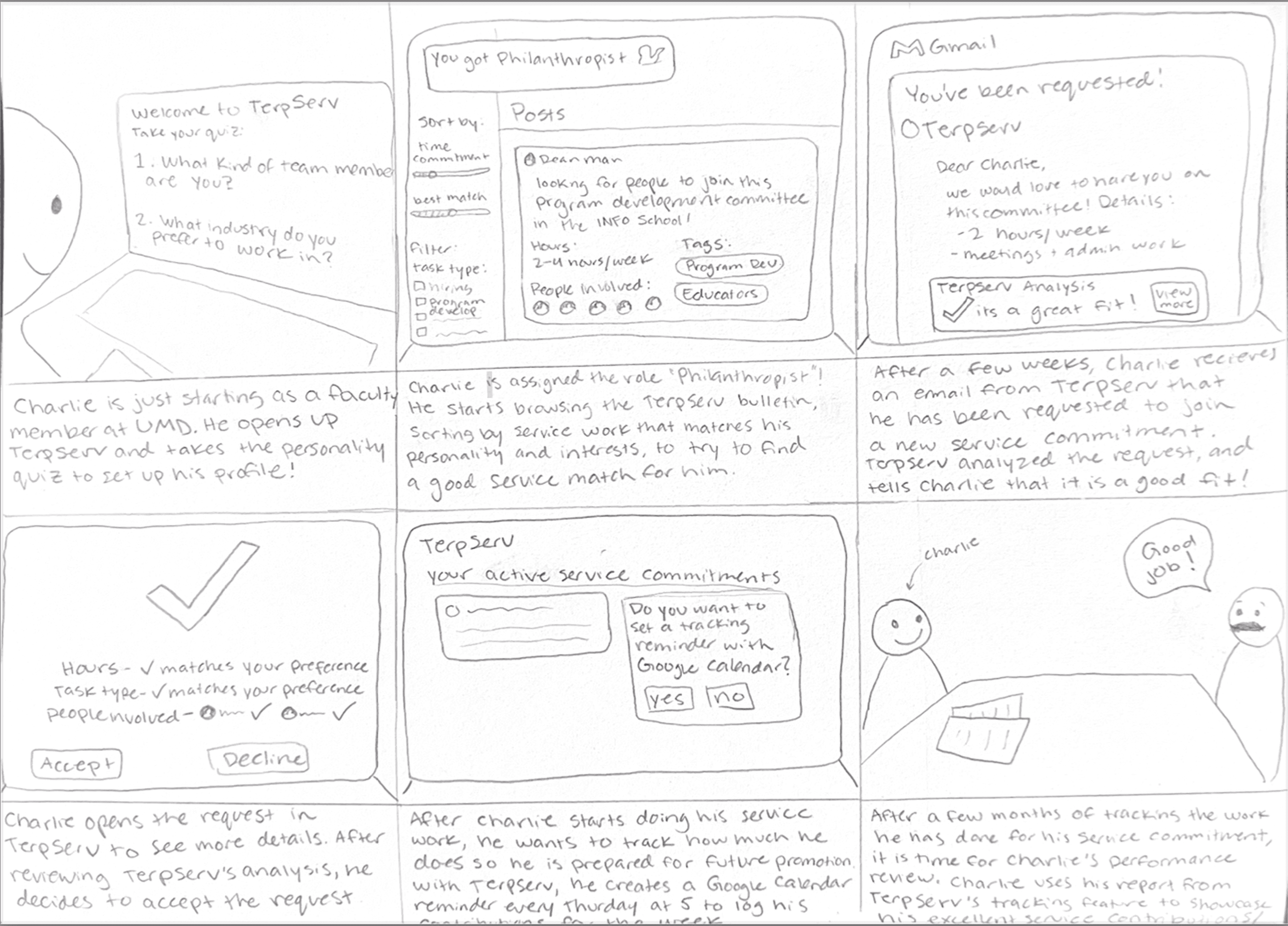
TerpServ is a design vision for a service bulletin board that centralizes service requests, contextualizes expectations, and supports faculty in making informed, values aligned decisions.
Final design vision
storyboard for TerpServ
Core Recommendations:
Centralized service visibility to reduce informal pressure
Upfront clarity on scope, time, and collaborators
Workload awareness through tracking and reflection
Community context embedded into decision making
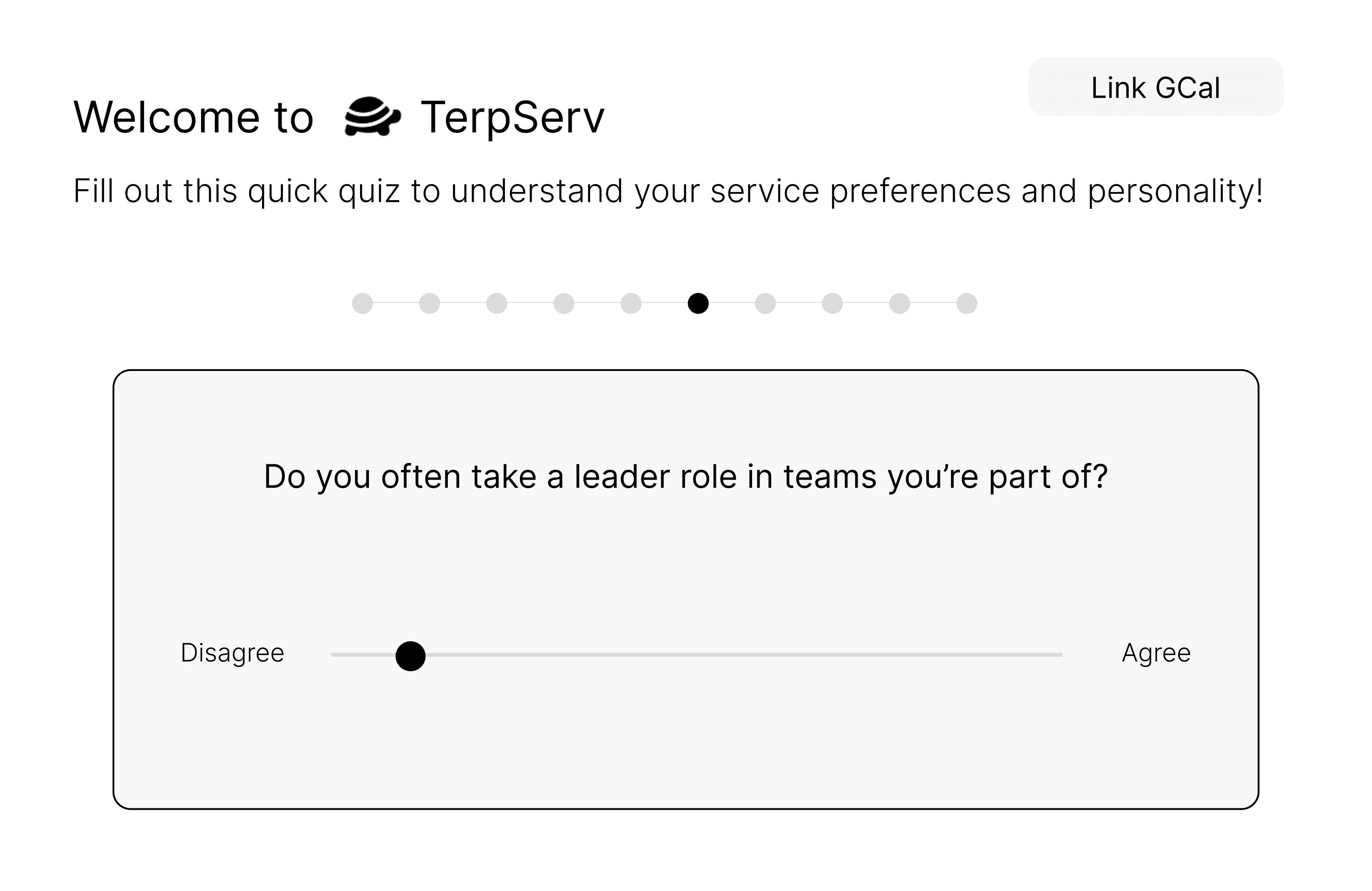
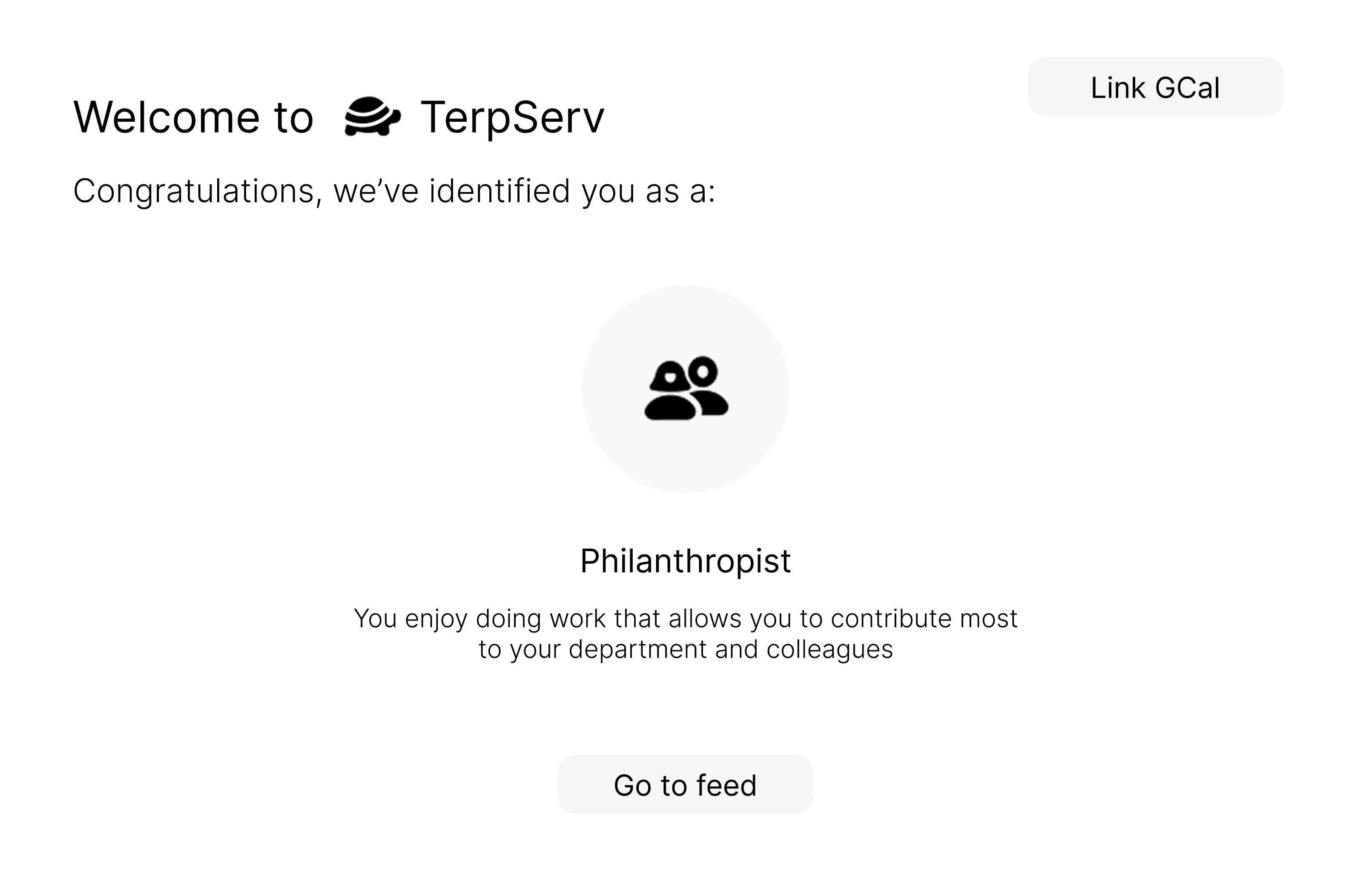
Service personality quiz to help match faculty to interested and suitable service opportunities
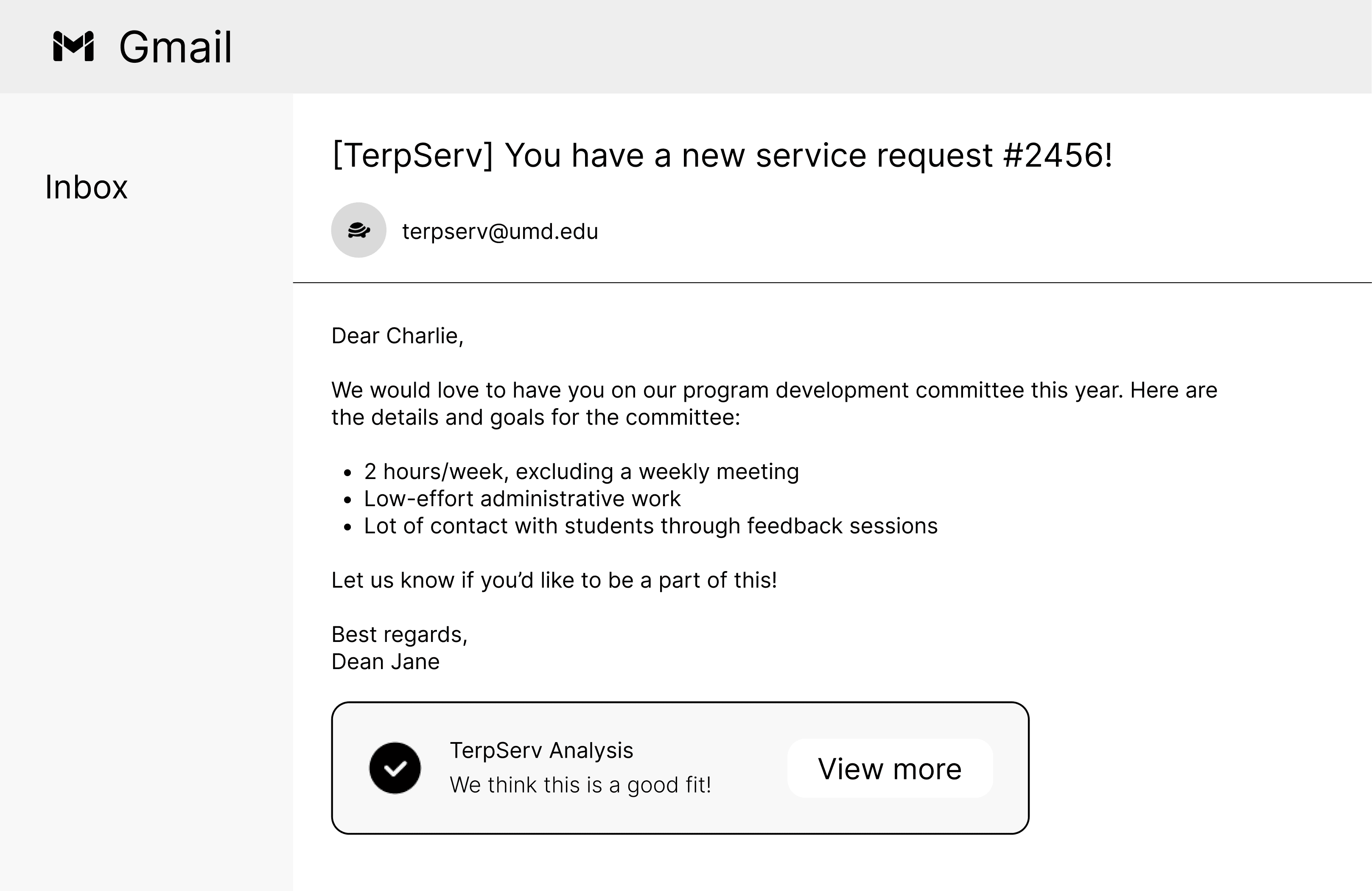
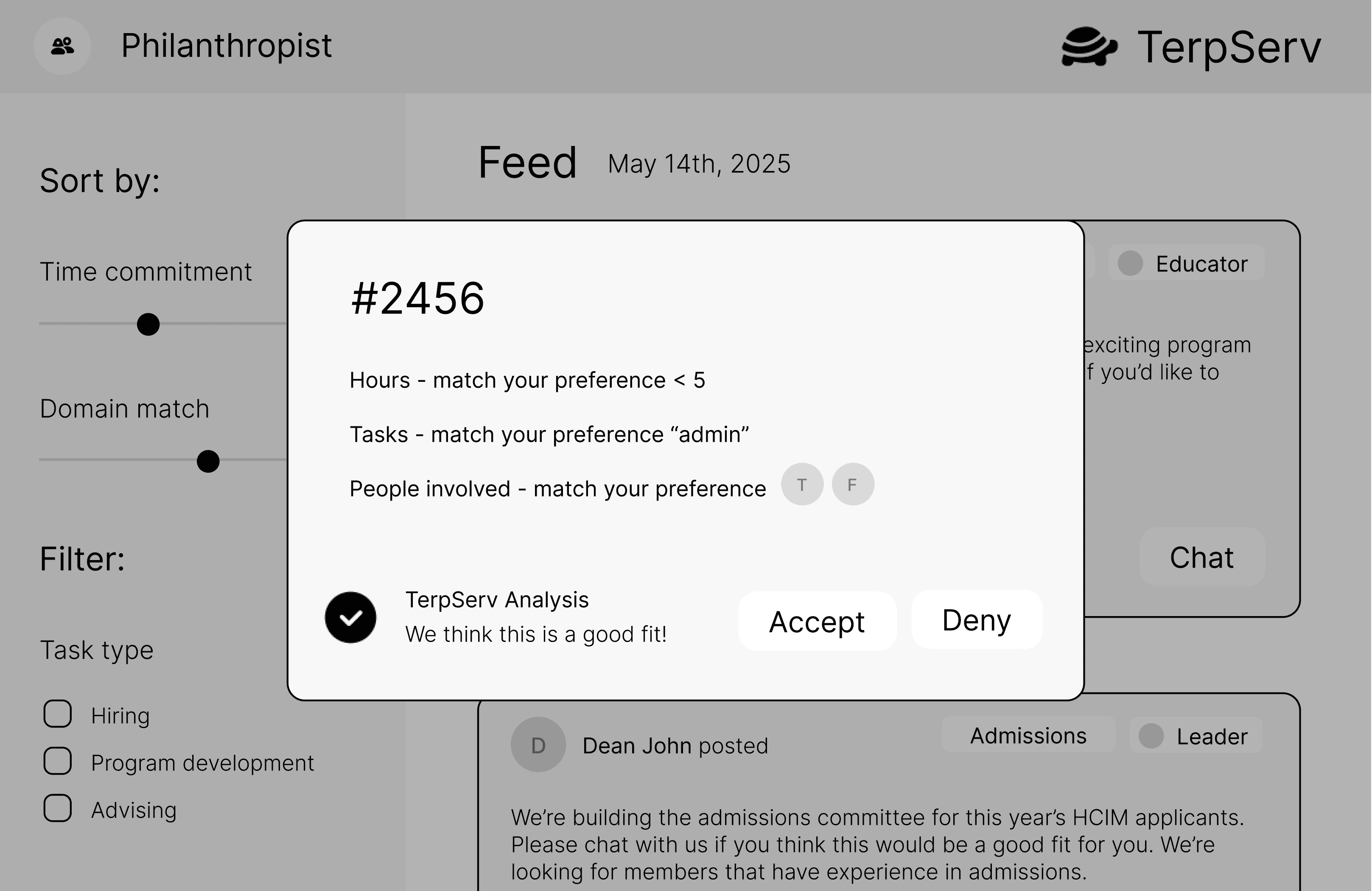
Service request notification and analysis to make decision making more informed and effortless
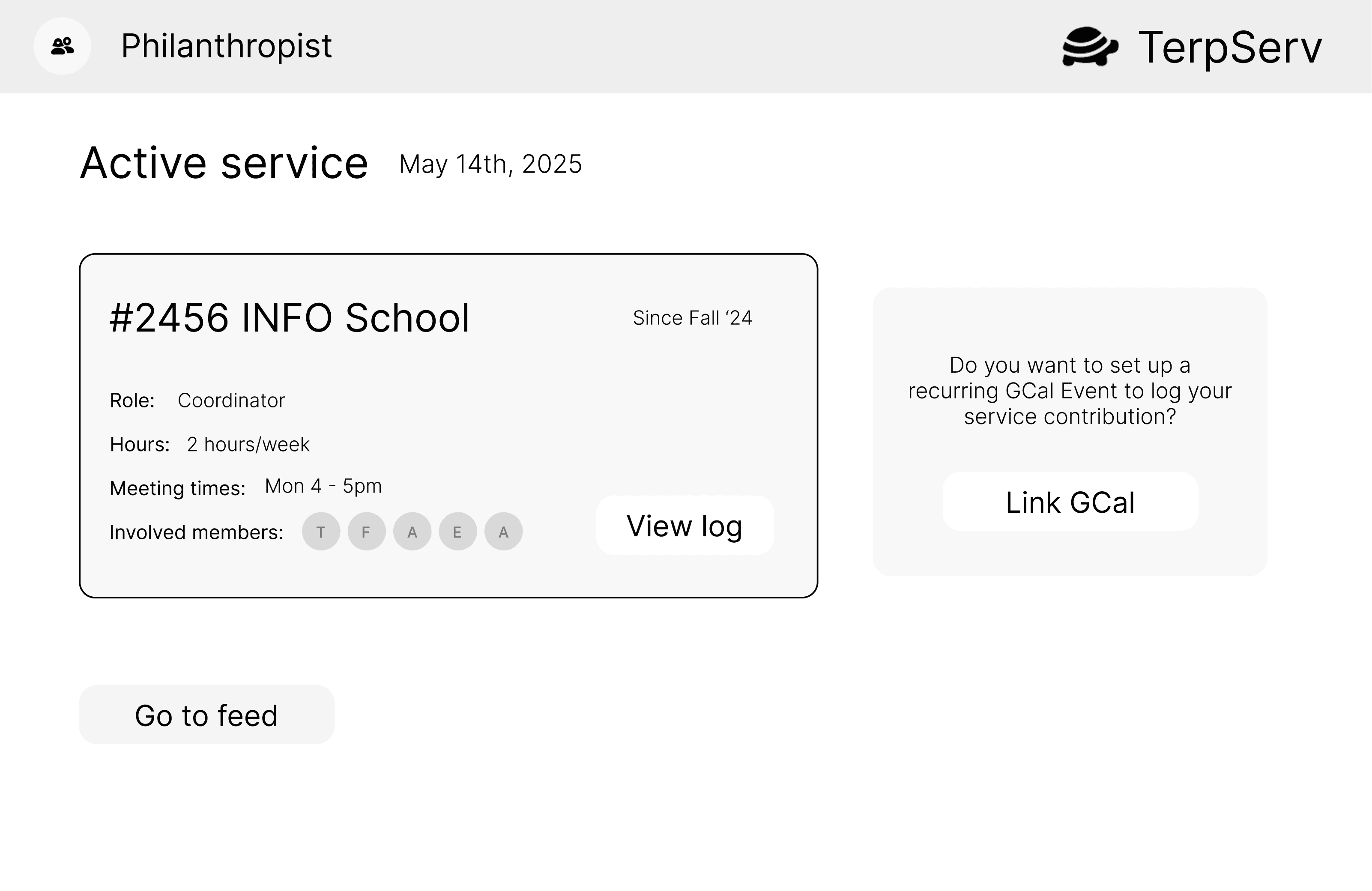
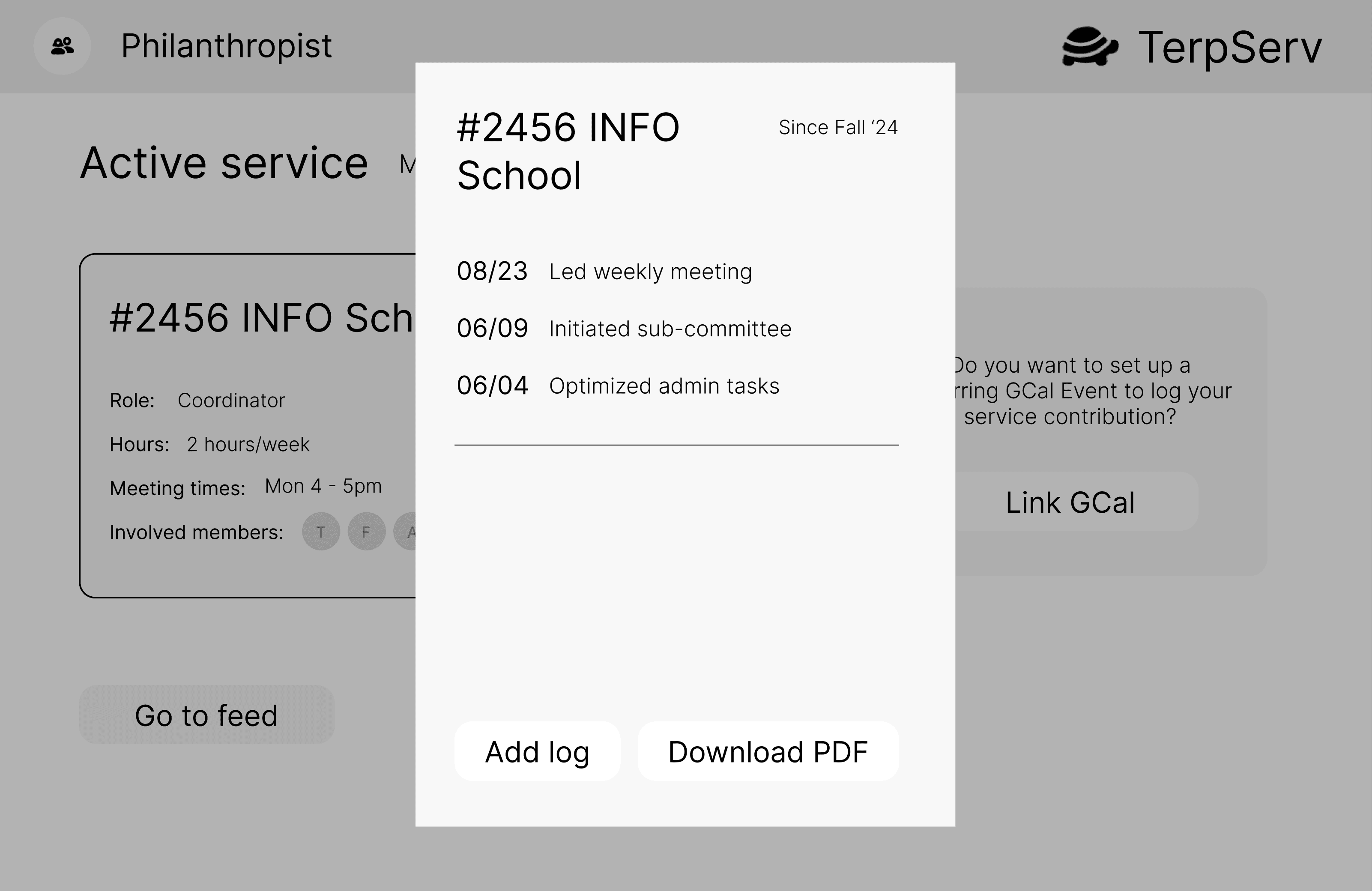
Tracking service requests and accessing logs to structure and organize service work
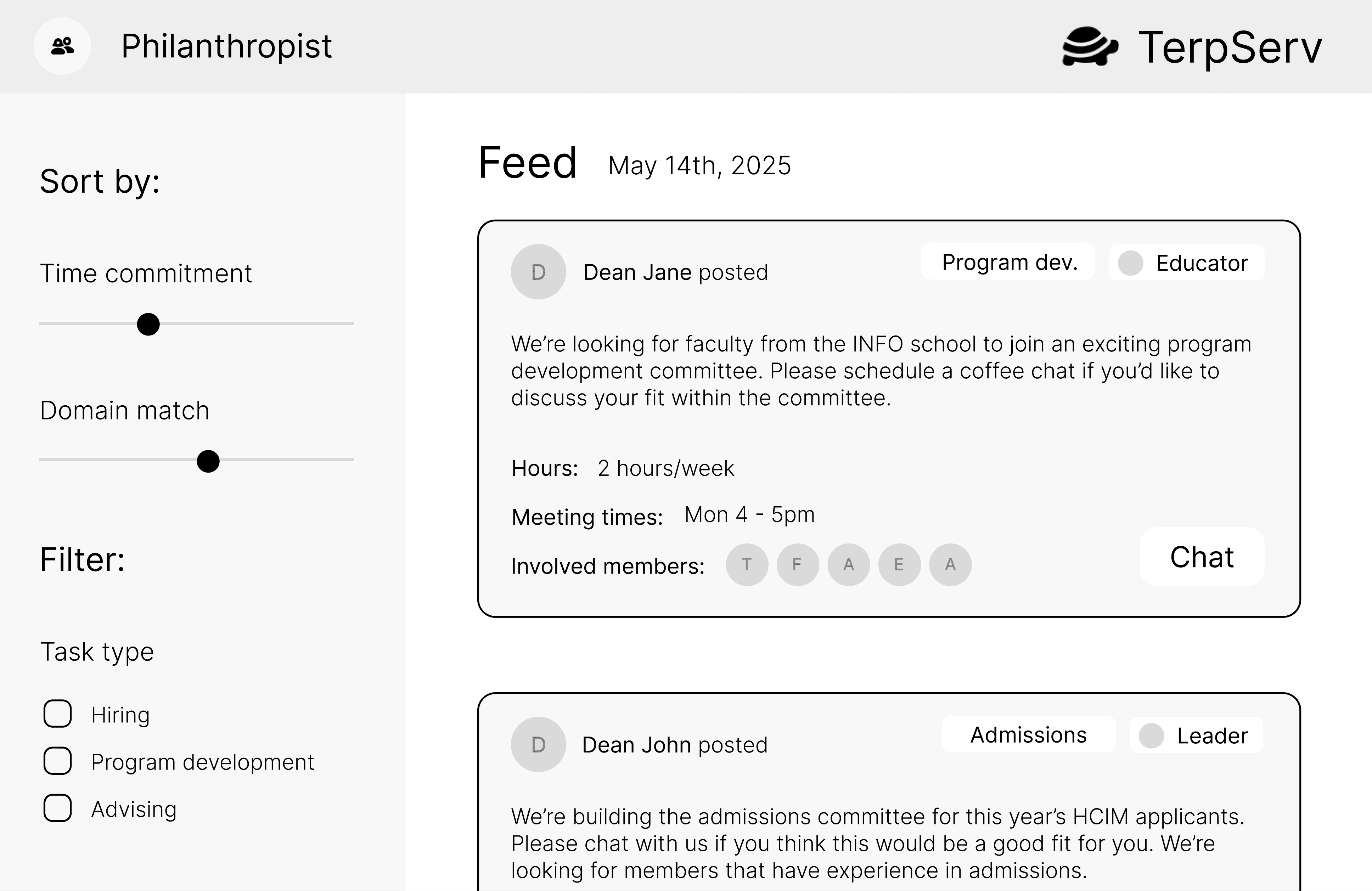
Curated service opportunities feed with filter and sort focusing on other faculty involved
REFLECTION
This project reinforced that good research does not simplify reality. It makes complexity legible.
Rather than prescribing a single product, our work produced a research grounded framework and set of design visions that the College can use to guide future tools, policies, and cultural initiatives around service work.
DESIGN RESEARCH ON FACULTY DECISION MAKING
An end-to-end qualitative research and synthesis project translating faculty practices into actionable design recommendations.
ROLE
UX Researcher, Team of 4
TIMELINE
4 months
CLIENT
College of Information,
University of Maryland
OUTCOME
Research Insights
and Design Visions
CONTEXT
Faculty in the College of Information balance teaching, research, and service. While teaching and research are structured and measurable, service work is informal, underdefined, and culturally loaded. Over time, this imbalance contributes to overload, misalignment with career goals, and burnout, especially for early career faculty.
Our clients, faculty members within the College, asked us to investigate how service decisions are actually made and how institutions might better support faculty in navigating them.
CHALLENGE
Faculty decision making does not follow linear or documented processes. Much of it happens through experience, negotiation, and improvisation, making it difficult to design effective institutional support without first understanding these underlying patterns.
RESEARCH QUESTION
How do faculty at the College of Information manage service expectations, and what factors influence their decisions to accept or decline service work in relation to their professional and personal priorities?
RESEARCH APPROACH
Our focus was not on outcomes, but on how faculty evaluated options, identified constraints, and navigated tradeoffs in real situations.
Methods:
Contextual interviews with faculty
Interpretation sessions to extract meaning from interviews
Affinity diagramming to surface themes
Modeling to structure decision logic
Speed dating survey to test early design directions
Participatory wall walk to validate insights and gather direction
FROM DATA TO MEANING
Interpretation Sessions
Each interview was followed by a structured interpretation session, allowing the team to collaboratively extract observations, tensions, and implications before memory or bias could set in.
During this phase, we explored multiple modeling lenses to understand faculty behavior.
|
Preliminary identity and decision
point models made during interpretation sessions
SYNTHESIZING INSIGHTS
The original one page form was restructured into a sectioned, step by step experience with clear progress indicators and a defined path to completion.
This reduced cognitive load and helped users understand where they were and what remained.
Affinity Mapping
Interview notes were distilled and iteratively clustered into themes. Over multiple sessions, patterns emerged that went beyond logistics and surfaced emotional, cultural, and relational drivers of service decisions.
|
First large theme identified was the influence of community in decision making
|
The second theme was the flaws of the service process that we identified
|
The last theme was how personal and professional goals impacted decisions
KEY INSIGHTS
Service is driven by community obligation, not availability
Faculty frequently accept service work out of care for students, colleagues, and departmental health even when it negatively impacts their workload.
Implication
Any solution that treats service as an individual optimization problem misses the social reality of academic work.
Lack of upfront information leads to reactive decisions
Faculty are often asked to commit to service without clarity around time, scope, or expectations.
Implication
Uncertainty pushes faculty to default to “yes” rather than make informed choices.
Service work is structurally invisible
Mentorship, advising, and informal labor are rarely tracked or acknowledged, despite consuming significant time.
Implication
Faculty lack evidence to reflect on or advocate for their workload.
Cultural and gendered expectations
amplify imbalance
Women and early career faculty reported higher pressure to accept service roles, often framed as being a “good departmental citizen.”
Implication
Service inequity is not accidental. It is reinforced by norms and power dynamics.
MODELING FACULTY DECISION MAKING
To translate insights into actionable structure, we created personas and a decision point model that reflected how decisions actually happen, not how institutions assume they do.
The decision model revealed that people and relationships consistently outweighed interest or alignment, reframing service acceptance as a socially negotiated act rather than a rational choice.
|
User personas to model insights about faculty and staff in the department in relation to the service request process
|
Decision point model to outline influences identified in the decision making process
TESTING EARLY
DIRECTIONS
Using insights from interviews and models, we created early concept storyboards and gathered rapid feedback for a speed dating survey
What we learned:
Faculty preferred clarity over complex planning tools
Knowing who they would work with mattered more than algorithmic matching
Community visibility increased trust and willingness to engage
|
Option 1 preferred by >65% of the participants
|
Option 4 preferred by >65% of the participants
VALIDATING WITH
THE COMMUNITY
We translated our findings into a physical wall walk and invited faculty to engage directly with the data, models, and early concepts.
This surfaced a second layer of insights, including a strong desire for shared visibility, peer context, and cultural change, not just tools.
|
The final wall walk display with the affinity diagram, content models and speed dating survey
|
College of INFO faculty interacting with the insights
|
Questions and design ideas suggested by the participants
FROM INSIGHTS TO RECOMMENDATION
Visioning
We synthesized wall walk feedback into four “hot ideas” and used a structured visioning process to explore possibilities without prematurely narrowing scope.
This allowed us to separate what was desirable from what was feasible, while preserving the integrity of our findings.
|
Example of an initial vision sketch
FINAL RECOMMENDATION : TERP SERV
TerpServ is a design vision for a service bulletin board that centralizes service requests, contextualizes expectations, and supports faculty in making informed, values aligned decisions.
Core Recommendations:
Centralized service visibility to reduce informal pressure
Upfront clarity on scope, time, and collaborators
Workload awareness through tracking and reflection
Community context embedded into decision making
|
Final design vision
storyboard for TerpServ
|
Service personality quiz to help match faculty to interested and suitable service opportunities
|
Service request notification and analysis to make decision making more informed and effortless
|
Tracking service requests and accessing logs to structure and organize service work
|
Curated service opportunities feed with filter and sort focusing on other faculty involved
REFLECTION
This project reinforced that good research does not simplify reality. It makes complexity legible.
Rather than prescribing a single product, our work produced a research grounded framework and set of design visions that the College can use to guide future tools, policies, and cultural initiatives around service work.